Posted in Literatura Inglesa y Discurso Político2 | No Comments »
Books:
1. Swift, Jonathan. Satires and Personal Writings, ed. William Alfred Eddy. London: Oxford university Press, 1932
2. Williams, Kathleen. Jonathan Swift and the Age of Compromise. Lawrence: University of Kansas Press, 1967
3. Fabricant, Carole. Swift the Irishman from The Cambridge Companion to Jonathan Swift, ed. Christopher Fox. Cambridge: Cambridge University Press, 2003, p.48-73
4. Mueller, Judith C. A Tale of a Tub and early prose from The Cambridge Companion to Jonathan Swift, ed. Christopher Fox. Cambridge: Cambridge University Press, 2003, p.202-216
Websites:
A. The Battle of the Books. A Tale of a Tub. A Modest Proposal. Drapier’s Letters.
On-line texts from Project Gutenberg <http://www.gutenberg.org/wiki/Main_Page>
Web site copyright © 2003-2010 Project Gutenberg Literary Archive Foundation.
Consulted: 25th November 2010
B. The Battle of the Books. A Tale of a Tub. A Modest Proposal. Drapier’s Letters.
From Wikipedia, the Free Encyclopedia <http://www.wikipedia.com>
Webmaster: Wikipedia® is a registered trademark of the Wikimedia Foundation, Inc.
Consulted: 25th November 2010
C. Cody, David. “A Modest Proposal”: an Introduction. Victorian Web.
< http://www.victorianweb.org/previctorian/swift/proposal1.html>
Webmaster: © 1995-2010 George P. Landow. All Rights Reserved.
Consulted: 25th November 2010
D. Jonathan Swift’s “The Battle of the Books” (1704)
From Restoration &18th Century Studies in English at Western (The University of Western Ontario)
< http://instruct.uwo.ca/english/234e/site/supplmts/bttlebooks.html>
Webmaster: Mark McDayter
Consulted: 25th November 2010
E. Kilkenny International Swift Society <http://www.swiftsociety.com/swift/swift_biog.html>
Webmaster: jnh@physics.dcu.ie
Consulted: 25th November 2010
F. The Cambridge History of English and American Literature. An Encyclopedia in Eighteen Volumes. Volume IX: From Steele and Addison to Pope and Swift. Edited by A. W. Ward & A. R. Waller
On-line text < http://www.bartleby.com/219/index.html#4>
From Bartleby.com, Great Books Online © 2010 Bartleby.com
Consulted: 25th November 2010
Posted in Literatura Inglesa y Discurso Político2 | No Comments »
I think, after the presented overview of Jonathan Swift’s probably most prominent and most famous works, it is possible to draw some conclusions.
It is easy to see that satire plays a very important role in Swift’s writings. You can hardly find any work by him which will not contain any ironic observations, either explicit or hidden. And the author’s “obsession” with this stylistic device is clear: you cannot criticize overtly those who are in power if you want to keep your position in society or, sometimes, even life. However, Swift’s ingenuity allows him to show current problems of his time and even state his point of view (even if sometimes it is very radical and goes against the opinion of the government). He knows that satire protects him from direct accusations and possibility to end up in jail or gallows.
As Swift’s major concern was about political and social issues of his country, he wrote nearly always about that. That is why nearly always we find his writings satirical and ironic. Without the protection of humour, sometimes good-natured, sometimes bitter, one could not talk about the problems of economy, religion, education, poverty, literature, knowledge, etc. as it would be extremely dangerous.
The nature of Swift’s satire can be very different. I think it depends on the topic the author deals with. Very often, if he speaks about some ambiguous questions as religion or literature, Swift uses softer and funnier satire. He does not sound categoric and does not impose any of his thoughts on the reader. Moreover, it can be difficult to understand his own attitude to the problem, probably because he does not want to support openly any of the participants of the conflict. He keeps the distance to be objective in his presenting the state of affairs to the reader.
However, sometimes the topic may be too serious or too painful for the author to laugh about it light-heartedly. Usually it is the topic about his motherland, Ireland, that provoked his bitterest satire. From time to time it may even stop looking as satire but turn into a political petition calling for action. The emotions of disappointment, anguish, worry and love for his country and his compatriots become too strong to be hidden under the cover of humour and irony.
In any case, Swift’s powerful weapon called satire proves to be a very effective one. With the help of it the author reveals and ridicules the flaws of his society and urges his contemporaries to act and rectify the situation, or, at least, to be aware of it.
Posted in Literatura Inglesa y Discurso Político2 | No Comments »
In this chapter I will briefly comment on some of less famous works by Swift. They are generally short essays which deal with different aspects of social and political life. (All the text references that I will be using in this chapter are taken from 1).
For example, “An Argument against Abolishing Christianity”, as suggested by the title, speaks about the problem of religion. This masterpiece of prose irony is sometimes so intricate and double-edged that the reader may find himself uncertain of Swift’s real attitude towards Christianity. Is he attacking Christians or unbelievers? The problem, however, is not as simple as that. He is attacking agnostics who used Christianity as a social convenience, who favoured the Establishment of the Church with the Gospel left out. To ridicule the absurdity of calling this state of affairs religion, Swift pretends to be himself one of these mercenary Christians, and presents the advantages which result from preserving the name of Christianity without the reality. To restore the latter, he admits, “would be to dig up foundations; to destroy at one blow all the wit, and half the learning of the kingdom; to break the entire frame and constitution of things; to ruin trade, extinguish arts and sciences, with the professors of them; in short, to turn our courts, exchanges, and shops into deserts”. To prevent such a disaster it is not necessary to be an infidel, it is enough if the nominal Christianity is kept. As on so many other pages, Swift seems to have written this essay for our generation as much as for his own. It suffices that trust in God is stamped on the coins, and that temperance is written into the [American] Constitution.
“A Letter of Advice to a Young Poet” – in this amusing satire Swift has sketched for us the tricks by which scribblers won publishers and readers without invoking the aid of the Muses. The title might be modernized to read, “How to write like Homer and Milton by working ten minutes a day. No education necessary. Send for our free booklet of easy rules”. “Possibly you may think it a very severe task, to arrive at a competent knowledge of so many of the antients, as excel in their way; and indeed it would be really so, but for the short and easy method lately found out of abstracts, abridgments, summaries, etc. which are admirable expedients for being very learned with little or no reading”. And on the corruption and mercenariness of the poets he adds: “Lastly, it will be your wisdom to look out betimes for a good service for your muse, according to her skill and qualifications, whether in the nature of a dairy-maid, a cook, or charwoman: I mean to hire out your pen to a party which will afford you both pay and protection”. For other satires on the same subject the reader is referred to the Scriblerus essays of Arbuthnot and Pope and to the delightful essay by Bishop Copleston “Advice to a Young Reviewer, with a Specimen of his Art”, 1807.
“A Letter to a Young Lady on her Marriage”: this letter is supposed to be addressed to Miss Betty Moore (at the time of her marriage to Mr. George Rochfort), who was not amused by its contents. Editors of Swift have debated among themselves with no little feeling the question of Swift’s lack of chivalry towards Lady Betty, and towards ladies in general. “I am afraid it will be hard for you to pick out one female-aquaintance in this town, from whom you will not be in manifest danger of contracting some foppery, affectation, vanity, folly, or vice”. Thus, Swift’s recommendation for a wife-to-be is to do the contrary to “whatever they shall say or do”, especially in the question of “managing… husbands”. Swift’s age, profession, and position as adviser to the very young girl gave him the opportunity to tell her some homely truths, candidly and rudely – truths which the amenities of social life would have prevented others from disclosing. Most men readers (and perhaps some ladies) will conclude in private what they may or may not be willing to admit to others: that Swift has here stated the case for husbands with commendable vigour. It is, of course, true that romance is utterly lacking in the married life he represents here, as elsewhere in his writings. Swift knew he was not a poet, and he was sensible enough to leave to others the task of rendering homage to love.
“An Essay on Modern Education” deals with the topic of education. It is clear that education today has lost some of the features with which the essay is concerned, but by no means all. Isn’t the following passage still true for our days? “…the same errors running through all families, where there is wealth enough to afford, that their sons (at least the eldest) may be good for nothing. Why should my son be a scholar, when it is not intended that he should live by his learning? By this rule, if what is commonly said be true, that money answereth all things, why should my son be honest, temperate, just, or charitable, since he hath no intention to depend upon any of these qualities for a maintenance?”
Seldom did Swift write genial, good-natured satire to better effect than in his little-known tract called “A True and Faithful Narrative of What Passed in London”. The superstitious fears spread abroad by astrologers, the absurdities of dissenting “fanatics” who announce the approaching end of the world, the hypocrisies of eleventh-hour penitents, the private morals of free-thinkers and maids-of-honour, are all touched in his happiest vein. The immediate subject of ridicule was the self-anointed prophet, William Whiston (1667-1752), who founded a freak religious society in 1717, who wrote his own autobiography as well as a score of books expounding Biblical prophecies, who carried up and down England a model of the Tabernacle of Israel as he lectured on the rebuilding of Solomon’s Temple, the restoration of Palestine to the Jews, and the second Coming of Christ in 1766: “But on Wednesday morning (I believe to the exact calculation of Mr. Whiston) the comet appeared: for at three minutes after five by my own watch, I saw it. He indeed, foretold that it would be seen at five minutes after five, but as the best watches may be a minute or too slow, I am apt to think his calculation just to a minute”.
Of course, there are many more interesting works by Swift, worthy of the close analysis, but I think these mentioned before, will be enough to give a general idea about Swift’s ingenuity and a broad range of topics he explored in his tracts. All of them can be treated as excellent examples of Swift’s original sense of humour and his satire.
Posted in Literatura Inglesa y Discurso Político2 | No Comments »
Ever since the reign of Charles II the right to mint and circulate copper coins in Ireland had been a privilege farmed out to private individuals. In dire need of a coinage established by law, as in England and Scotland, the Irish government petitioned Parliament in 1720 to establish copper coins of guaranteed, intrinsic value. The petition was ignored, and a patent to issue the coins was granted to William Wood, a hardware merchant, 12 July 1722, in return for handsome bribes paid by Wood to the king’s mistress. Although the country was in fact suffering from a serious money shortage, the project provoked immediate and widespread opposition for several reasons: the large amount of coinage it authorized, far in excess of what the country needed; the absence of safeguards to ensure the intrinsic worth of coins; the perception that the patent was obtained through political graft; and smoldering resentment at Ireland’s inability to mint its own money. Public indignation in Ireland flared high, and was fanned higher by the anonymous “Drapier’s Letters” actually written by Swift. The immediate effect of the letters was to unify Irish parties in a solid front against Wood and Walpole, and to make Swift the hero of the hour. The Irish decorated and thronged the streets when the “Drapier Dean” rode into Dublin. They proposed tearing down the statues of “military murderers” to erect statues of Swift, the savior of their country. These “Drapier’s Letters” explain what so many commentators have understated: the popularity of Swift with the common people of Ireland; and they refute the libel that he was cold to the sufferings of his fellow men. Furthermore, he was one of the few men living who could make Walpole look like a fool, and the Irish were grateful for that.
The First Letter
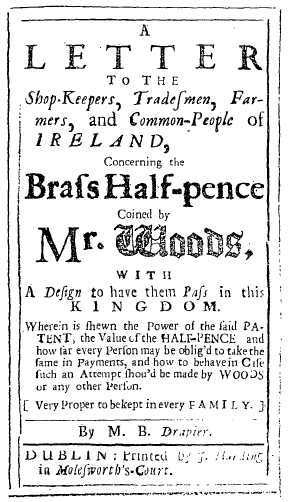 Each letter presents the issues in a lucid, forceful, and engaging manner, especially appropriate to the specific individual or group being addressed while also appealing to a broader audience. The “First Letter”, for example, which directs its polemic “To the Shop-Keepers, Tradesmen, Farmers, and Common-People of Ireland”, sets forth the situation in simple language so that is can be understood by those with little education, with whom there was no sense in using complex legal or constitutional arguments: “I will therefore first tell you the plain story of the fact; and then I will lay before you, how you ought to act in common prudence, and according to the laws of your country.” (A. From now on I will use this online text as a reference for the quotations). Targeting those people whose horizons are defined by the everyday struggle for survival, the Drapier represents the adverse effects of accepting Wood’s halfpence in terms of concrete deprivations in their daily lives, warning that they would have to pay at least two hundred of these debased coins for “a yard of ten-penny stuff” and that “any person may expect to get a quart of two-penny ale for thirty six of them”.
The Second Letter
The Drapier’s second letter, “A Letter to Mr. Harding the Printer, upon Occasion of a Paragraph in his News-Paper of 1 August, relating to Mr. Wood’s Half-Pence” deals with Wood’s responses at a hearing before the English Privy Council to the charges made by the Irish parliament, especially his undertaking to raise the amount coined to £40,000 when in fact, Ireland’s total requirement for copper money was £25,000. Though the Drapier argues that the king would never accept a patent that could harm Ireland and would never act in such a way as to help Wood harm the people of Ireland, it is clear that he ironically insinuates that the king does exactly the opposite – he does not protect the rights of the Irish people at all. “The King never issues out a proclamation but to enjoin what the law permits him. He will not issue out a proclamation against law, or if such a thing should happen by a mistake, we are no more obliged to obey it than to run our heads into the fire. Besides, His Majesty will never command us by a proclamation, what he does not offer to command us in the patent itself. There he leaves it to our discretion, so that our destruction must be entirely owing to ourselves”.
The Third Letter
The Drapier’s third letter, “To the Nobility and Gentry of the Kingdom of Ireland: Some Observations Upon a Paper, Call’d, The Report of the Committee of the Most Honourable the Privy-Council in England relating to Wood’s Half-pence”, was printed on 25 August 1724. It deals with an examination of the precise terms of Wood’s patent and a refutation of the Report of the Committee of the Privy Council in England which found in Wood’s favour. Obviously directed at a more literate group than the addressees of the “First Letter”, this epistle focuses on a world of documents in need of careful analysis. For this audience the Drapier can elaborate upon the complexities of the “Doctrine of Precedents”, as he can also strategically play upon his readers’ sense that as members of a high social class they are equal with their English brethren: “Were not the people of Ireland born as free as those of England?…Am I a free-man in England, and do I become a slave in six hours, by crossing the channel?”
The Fourth Letter
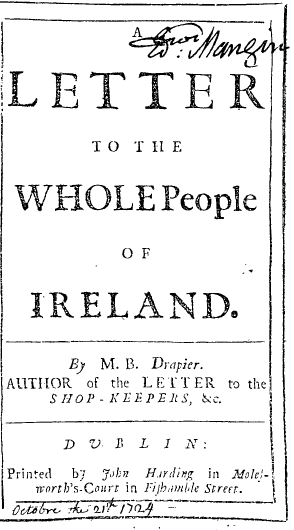 The “Fourth Letter” appeared on the 13th of October in 1724, signed, as the others had been, “M. B. Drapier”. A proclamation was issued by the Lord-Lieutenant of Ireland, 27 October, offering three hundred pounds reward “to such person or persons as shall within the specified six months from this date hereof, discover the author of the said pamphlet, so as he be apprehended and convicted thereby”. Swift immediately let it be known that he was the Drapier, and defied arrest. The Lord-Lieutenant discreetly did nothing. To arrest Swift would have been to get himself promptly lynched by the mob.
This letter, “To the Whole People of Ireland”, is the most radical and potentially subversive of the Drapier’s tracts. The author is addressing a much broader audience than previously, one defined as a unified national entity rather than as a particular class or trade (it is written for “people of all ranks, parties, and denominations”, including “great numbers of farmers, cottagers, and labourers” and “faithful friends the common people”). In this letter Drapier combines the concrete detail of the “First Letter” with the more conceptual and analytical points of the third to attack Wood’s coinage scheme and defeat it. Here as elsewhere, Swift’s calls for unity reveal the conception of patriotism that he urged as a model of conduct for his fellow countrymen. By patriotism Swift explains the necessity that even “a tradesman hid in privacy and silence should cry out when the life and being of his political mother are attempted before his face”. The identification of Ireland rather that England as the Anglo-Irishman’s “political mother” demonstrates Swift’s advocacy of Ireland’s interests. To show his identification with the Irishmen, Swift uses the language as a weapon. Thus, referring to reports that the English Prime Minister, Robert Walpole, has given the Irish an ultimatum, “either [to] take [Wood’s] half-pence or [to] eat our brogues” – the latter term signifying rude shoes made of untanned hide, commonly worn by the rural and lower classes in Ireland (though no doubt also punning on “brogue” as the distinctive dialect of the Irish) – the Drapier assures his readers these reports must be false since “I am confident Mr. Walpole never heard of a brogue in his whole life”. The Drapier focuses on “brogue” as a term that clearly separates the English from the Irish, constituting a distinctive marker both of Irish existence, and of English ignorance about that existence. Swift uses the commonest objects of the lowliest inhabitants of the country as symbols of the Irish nation as a whole, assuring his readers, “we are perfectly safe from Walpole; and shall…be left to possess our brogues and potatoes in peace”. The image of the Irish patriot as brogue wearer and potato eater is perhaps Swift’s boldest contribution to the struggle against Wood’s halfpence. It ensures his identification with a larger, more inclusive Ireland than the one represented by others of his class.
The other letters
There were three more letters written after the one dedicated “To the Whole People of Ireland”, however they are less powerful and do not present much interest for us. The Drapier’s fifth letter, “A Letter to the Honourable the Lord Viscount Molesworth, at his House at Brackdenstown, near Swords” was published on 31 December 1724. The letter includes the most pseudo-biographical information on the Drapier and presents the final salvo in the Drapier’s fight against Wood’s patent. The sixth letter, “To the Lord Chancellor Middleton”, is dated 26 October 1724, and was written as a private letter from Jonathan Swift to Alan Brodrick, Lord Midleton (with the misspelling of his title). The purpose of the sixth letter was to ensure that Midleton would stay true to his opposition of Wood’s patent. The Drapier’s last letter, “A Humble Address to Both Houses of Parliament”, was completed in June 1725. It was written before Wood’s patent was defeated, and it was stopped from being printed when word reached Swift that the patent had been withdrawn. This letter remained unpublished for 10 years. It challenges the Ireland’s parliament to investigate how Wood originally attained the patent, even though most in power knew that the patent was the result of bribery.
So, these pamphlets were Swift’s great contribution to the defense of Ireland from Wood’s harmful intrusion. Though these letters were condemned by the Irish government (with the “help” of the British government, no doubt), they remained popular among Irish people, inspiring their resentment against Wood’s unjust acts and supporting their patriotism and loyalty to their national identity.
Posted in Literatura Inglesa y Discurso Político2 | No Comments »
Motives for writing “A Modest Proposal”
Swift’s motives for writing “A Modest Proposal”, which appeared in 1729, were complex. He felt, for his own part, that he had been exiled to Ireland when he would have much preferred to have been in England, and his personal sense of the wrongs he had received at the hands of the English only intensified the anger he felt at the way England mistreated Ireland. He lived in an Ireland which was a colony, politically, militarily, and economically dependent upon England. It was in England’s interest to keep things as they were: a weak Ireland could not threaten England, and the measures which kept it weak were profitable for the English. As a result Ireland was a desperately poor country, overpopulated, full, as Swift said, of beggars, wracked periodically by famine, heavily taxed, and with no say at all in its own affairs. England controlled the Irish legislature. English absentee landlords owned most of the land which was worth owning. Irish manufactories were deliberately crippled so that they could not compete with those in England.
Swift was enraged at the passivity of the Irish people, who had become so accustomed to the situation that they seemed incapable of making any effort to change it. The Irish Parliament ignored numerous proposals which Swift made in earnest — proposals to tax absentee landlords, to encourage Irish industries, to improve the land, agricultural techniques, and the quality of manufactured goods — which would have begun to rectify things.
“A Modest Proposal”, then, is at once a disgusted parody of Swift’s own serious proposals, as well as those of less disinterested «projectors,» and a savage indictment both of the exploitive English and of the exploited Irish. (C)
Question of beggars
Swift’s opening paragraph offers the reader a horrible but realistic picture of Ireland full of beggars. He makes a special emphasis on women and children, who are unable to work, and so they are forced to beg. In this opinion Swift contradicts the prevailing thought of his days when it was believed that if a person was poor and had to beg, it was his own fault. Thus it may seem that the author takes sides with the poor, however it is never totally clear. It is more likely that Swift criticizes the whole society: both the beggars and those who led the country to such a state of poverty. In a few lines that describe the future that the children will have when they grow up, Swift mocks the national politics of Ireland: “…infants who, as they grow up, either turn thieves for want of work, or leave their dear native country, to fight for the Pretender in Spain, or sell themselves to the Barbadoes”. (A. From now on I will use this online text as a reference for the quotations). We see that there is a lack of national integrity and loyalty to the native country, as people, not being able or not wanting to live in it, escape to other countries, where they can earn money and live in better conditions. Ireland does nothing to support its own inhabitants.
Probably, the careless way in which Ireland treats its own population finds its reflection in Swift’s description of people, especially mothers and children, as if they were animals and interested us merely in economic terms. Women are presented as breeders, and children are portrayed as something that can become financially valuable and profitable: “they shall, on the contrary, contribute to the feeding, and partly to the clothing of many thousands”.
Soon the problem of beggars among women and children becomes a pure economic argument. Despite his own moral indignation, when the author suggests that most abortions are occasioned by financial rather than moral considerations, he assumes that people’s motivations are basically materialistic. This is not, of course, Swift’s own assumption but a real fact: “There is likewise another great advantage in my scheme, that it will prevent those voluntary abortions, and that horrid practice of women murdering their bastard children, alas! too frequent among us, sacrificing the poor innocent babes, I doubt, more to avoid the expense than the shame, which would move tears and pity in the most savage and inhuman breast”.
The real meaning of “A Modest Proposal”
Of course, Swift’s proposal to eat children cannot be taken seriously. The literal reading of this pamphlet will not do. It should be read as an ironic representation of the degrading nation. On the one hand, the idea of cannibalism can be linked to the British oppression that nearly “devours” Ireland in a cannibalism of injustice and inhumanity. But on the other hand, it can refer to the nation itself. It consumes its own resources, it consumes itself without any compensation, thus leading the whole nation to destruction: the wealthy landlords “devour” most of the poor tenants, Irish people regard marriage and family values with so little sanctity, that they become nothing more than breeding animals (the fact that they need an economic inducement to marry, to love their children and spouses, and to refrain from domestic violence are obvious strikes against them), general baseness and lack of self-respect in Irishmen – all this leads to self-elimination as a nation.
The rich class
The rich class also receives its blow in “A Modest Proposal”. Swift criticizes the practice of absenteeism among Irish landlords, who often governed their estates from abroad, thus gathering the fruit of the labour of Irish peasants, taking the money out of the Irish economy and putting it into the British one. Swift’s contempt for the irresponsibility, greed, and moral indifference of the wealthy is matched only by his disgust at the utter failure of Ireland’s political leaders. So, the problem of poverty turns into a real problem of building a viable Irish national economy.
Catholic Church
There is also irony directed towards Catholic Church which is presented as an enemy, which is going to deliver the whole country to the devil, and which is famous for its excessively high tithes: “For first, as I have already observed, it would greatly lessen the number of Papists, with whom we are yearly over-run, being the principal breeders of the nation, as well as our most dangerous enemies, and who stay at home on purpose with a design to deliver the kingdom to the Pretender, hoping to take their advantage by the absence of so many good Protestants, who have chosen rather to leave their country, than stay at home and pay tithes against their conscience to an episcopal curate”.
The necessity of improvement
There author’s account of other proposals may be taken as Swift’s own. His list of supposedly unrealistic alternative solutions marks a turning point in the pamphlet and a break in the satire. The ideas the proposer rejects represent measures that Swift himself thought of and proposed, however with little effect. They are a set of steps by which the Irish might hope to break out of their problems, or at least some of them, without the need for England’s cooperation: “Of taxing our absentees at five shillings a pound: Of using neither cloaths, nor houshold furniture, except what is of our own growth and manufacture: Of utterly rejecting the materials and instruments that promote foreign luxury: Of curing the expensiveness of pride, vanity, idleness, and gaming in our women: Of introducing a vein of parsimony, prudence and temperance: Of learning to love our country, wherein we differ even from Laplanders, and the inhabitants of Topinamboo…”, etc. Swift wanted to make a change from the inside and he offered some real and practical solutions for that, which, unfortunately, were not supported.
Swift emphasizes the backwardness that is evident in Ireland. The country where cannibalism can become a real social improvement is, certainly, in a terrible condition. The situation seems to be so bad that it is better for people to die than to live suffering: “…they would […] think it a great happiness to have been sold for food at a year old, in the manner I prescribe, and thereby have avoided such a perpetual scene of misfortunes, as they have since gone through, by the oppression of landlords, the impossibility of paying rent without money or trade, the want of common sustenance, with neither house nor cloaths to cover them from the inclemencies of the weather, and the most inevitable prospect of entailing the like, or greater miseries, upon their breed for ever”.
So, we can conclude that “A Modest Proposal” is a manifestation of Swift’s sense of anger and frustration, and as such it is merely the most savage, the most brutal, the most heavily ironic, of the numerous tracts which he produced during the early eighteenth century in an attempt to shame England and to shock Ireland out of its lethargic state. It is a ghastly masterpiece, cunningly devised, horribly plausible, deviously manipulative: it remains for the reader to come to terms with it, to comprehend it, and to determine the extent to which, oddly enough, it might be relevant in our own world.” (C)
Posted in Literatura Inglesa y Discurso Político2 | No Comments »
 The problem of Swift’s relationship to Ireland has already been touched upon in my First Paper in the post called “JONATHAN SWIFT’S POLITICAL BELIEFS”. It is easy enough to see that this relationship was not easy. There are contradictions at its very core, suggested, on the one hand, by Swift’s own often conflicting statements about his place of birth and antithetical attitudes he expressed about his native land, and, on the other hand, by divergent views about the author, put forward by readers over the years, especially when they have to decide whether to locate Swift in a primarily Irish or English context.
In any case, we can disagree about the precise nature and meaning of Swift’s ties to Ireland, but there can be no disputing about the existence of the strong connection. Ireland was a kind of umbilical cord for Swift which, though sometimes denied or concealed, was never cut. Moreover, it strengthened greatly during the final quarter-century of his life. It was the place where he was born, thus it was an integral part of his identity, an essential ingredient in the way he viewed the world, an indispensable thread in the recurrent patterns of his writings.
Ireland has long been a land known for the emigration or self-exile of its greatest writers, and during Swift’s time, for the frequent and lengthy departures of its “absentees”: a term referring principally to the wealthy landlords reviled by Swift, but also applicable to the literary figures – William Congreve, Richard Steele, George Farquhar – born and raised in Ireland, who left to seek their fortunes across the water. But in Swift, Ireland could boast of one of its most faithful sons, one who spent over fifty years on its soil and who could look upon those who came and went with scorn and humour, portraying them as “Birds of Passage” and as “Soldiers who quarter among [the Irish] for a few months” and then depart, like seducers of young women.¹ To be sure, Swift might himself have become one of these “Birds of Passage” had he obtained the preferment in England he hoped for during the lengthy period he spent there from 1689 until the year 1714, when he returned to Ireland for good. But speculating now about how Swift’s life might have been different is pointless, for the fact remains that he (like the Fairfaxes in Andrew Marvell’s poem “Upon Appleton House”) “made destiny his choice” and came to actively embrace the varied roles that Ireland offered him: as churchman, pamphleteer, political activist, and general thorn in the side of the very establishment upon which his own position as Anglican dean depended. (3)
Thus, Ireland was an extremely important part of Swift’s life that had great influence on his writing.
Posted in Literatura Inglesa y Discurso Político2 | No Comments »
“A Tale of a Tub” was the first major work written by Jonathan Swift, composed between 1694 and 1697 and published in 1704. It is arguably his most difficult satire, and perhaps his most masterly. The “Tale” is a prose parody which is divided into sections of «digression» and a «tale» of three brothers, each representing one of the main branches of western Christianity.
 The structure and purpose of “A Tale of a Tub”
“A Tale of a Tub” begins with a train of prefatory matter, including a list of fictitious “Treatises wrote by the Same Author”, two letters of dedication, a letter from “The Bookseller to the Reader”, a Preface and an Introduction. In 1710 Swift added an “Apology” to defend his work. The tale proper – a story about three brothers and the coats their father wills them – begins in section II, but not for long. The remainder of the text alternates between sections devoted to this story and digressions with such titles as “A Digression in the Modern Kind” and “A Digression in Praise of Digressions”. Finally, the tale disappears altogether and the text ends with a conclusion in which the narrator resolves to “write upon nothing”. (A. From now on I will use this online text as a reference for the quotations.)
The structure of “A Tale of a Tub” – its copious prefatory material and its digressiveness – seems determined to keep the reader from the heart of the matter. In fact, the “Tale”’s narrator claims in the Preface that the purpose of his work is not so much to say something as to divert the attention of those who would attack religion and government: just as “sea-men have a custom when they meet a whale, to fling him out an empty tub, by way of amusement, to divert him from laying violent hands upon the ship”. The monstrous whale threatening the ship of state, according to the narrator, is Thomas Hobbes’ influential “Leviathan” and the imitations it inspired; the empty tub is the “Tale” itself. The reader should not trust the purpose implied in this metaphor, however, as the tub is hardly empty, and the “Tale”’s narrator proves no great champion of his stated cause.
Despite its complications, the “Apology” to the “Tale” offers a more reliable account of the purpose and structure of the work. Swift explains that he intended to satirize “the numerous and gross corruptions in religion and learning”. He wants to expose “abuses in religion” in the tale of the three brothers, and “those in learning he chose to introduce by way of digressions”.
Satire on modern learning and print
Swift’s satire in abuses in learning in the “Tale” has different targets, all of which he considered dangerous to the nation. He criticizes everything modern, including modern writing and modern philosophy. Swift parodies modern book titles and provides a list of “Treatises wrote by the Same Author” of the “Tale”, including “A General History of Ears” and “A Panegyrick upon the World”, titles that reflect the banal and reductive thinking Swift ridicules throughout the “Tale”.
Besides, the author has another target for his criticism – the power of print. Swift wrote “A Tale of a Tub” after the lapse of the Licensing Act, at a time when printed materials began to proliferate as never before and literacy rates were rising among all social classes. The appearance of words in print somehow gave them authority, and this worried Swift. He feared the subversive effects of bad books on undiscerning readers. Like other Ancients, he believed that bad ideas and bad writing weaken a civilization. So, “A Tale of a Tub” is a mock-book that seeks to awaken its readers’ discernment. In its extravagant textual apparatus, its lengthy prefatory matter, and ample footnotes, Swift’s “Tale” demands our questioning its authority and recognizing its dangers. The readers have to be careful while reading modern writings because they can contain hazardous ideas. Not everything that is written has a firm authority and thus, not every book is good for us to read.
Satire on religion
In the “Tale” proper – the story of the three brothers – Swift’s reader must identify the terms of the religious allegory. A father (God) leaves his three sons coats (the Christian faith) and directions for the proper care of their coats in a will (the scriptures). If the sons abide by the will, their coats will last and fit them properly through all changes. The will “consisted wholly of certain plain, easy directions about the management and wearing of their coats”. Swift presents the scriptures as a “plain text” and affirms that it does not require any interpretation. Its meaning and authority lie on its surface, it is self-evident, plain. The author mocks the readers like the three brothers who disregarded the authority of their father’s will and tried to interpret it.
Swift suggests that the interpretation of sacred texts is typically motivated by something other than the desire to know God’s will. In order to pursue their pleasures and to follow the latest fashions, the brothers twist and wring unintended meanings from the will. Brother Peter (Catholicism) distinguishes himself early as a shrewd interpreter. The father’s will, we are told, “was very precise”. The sons were “not to add to, or diminish from their coats, one thread, without a positive command in the will”. Through perverse interpretations of the will itself, nonetheless, Peter justifies adding forbidden adornments. The ultimate motive for scriptural interpretation becomes evident as Peter uses it for power, first over his brothers and then over the world. Peter’s attempts to force the text show a pride that knows no bounds. By his final appearance in the “Tale” he is calling himself “God Almighty and sometimes Monarch of the Universe”. However, the father’s plain text finally proves an obstacle to Peter’s desire, so Peter eventually stops reading altogether and locks up the will in a strong-box. This represents the early history of the Catholic church when it was denying the laity access to the scriptures. The locked box also represents the practical fate of any text subject to a corrupt reader’s will. Captive to a self-serving interpretation, the written word finally has no say.
In the allegory’s depiction of the Protestant Reformation, Peter’s two brothers – Martin and Jack – eventually break from him and retrieve the will. Although they resolve to “reduce all their future measures to the strictest obedience prescribed therein”, corrupt interpretation soon returns. The figure of Jack represents Protestant dissenters and various fundamentalist sects. Jack can bring to mind not only John Calvin but also the representatives of Puritans and Presbyterians, Methodists and Quakers, Baptists and Independents. Though Jack’s style of interpreting differs greatly, he abuses the will as shamelessly as Peter. While Peter hunts for arcane signs and allegorizes, Jack literalizes in ways that prove equally distorting. If the will expressly forbids additions to their coats, then Jack will tear and rend frantically until all additions are removed, heedless of the damage he does to the fabric of the coat itself. Jack’s behaviour here reflects the actions of violent Protestant sects; not only does his tearing recall their vandalizing of Catholic churches and monuments during the Reformation, it also suggests the damage Swift believes their divisiveness has done to the Christian faith itself. In his interpretative passion, Jack rips his coat to shreds. Again, Swift stresses the motives for interpretation, in this case, malice towards the Catholic Church: “the memory of Lord Peter’s injuries, produced a degree of hatred and spight which had a much greater share of inciting [Jack] than any regards after his father’s commands”. Like Peter, Jack is deluded. Unconscious of his own base motives, he believes his fanaticism to be righteousness. Passion and pride propel both brothers’ styles of interpretation, and Jack finally resembles Peter.
The third brother, Martin, probably named after Martin Luther but generally thought to represent the Anglican Church, offers an altogether different style of reading. Martin resolves to keep some additions to his coat when their removal would damage the fabric of the coat itself, “which he thought the best method for serving the true intent and meaning of his father’s will”. Swift stresses the plainness of the will, but even Martin must interpret beyond its simple terms. As much as the author would like to suggest otherwise, interpretation seems inevitable. Of course, most texts, including the actual scriptures, are not as plain and simple as the father’s will. Texts are typically read in complex circumstances like Martin’s, in which he must determine how to obey laws that have already been violated.
Which brother does Swift support?
But does Martin present the best way of interpreting the father’s will? Some readers have doubted whether Martin offers an attractive alternative to Peter and Jack. On one hand, Swift stresses Martin’s radical differences from his brothers. When Jack tells Martin “Tear, pull, rent, flay off all, that we may appear as unlike the rogue Peter, as it is possible”, Martin responds calmly “Peter was still their brother…It was true, the testament of their good father was very exact in what related to the wearing of their coats; yet was it no less penal and strict in prescribing agreement, and friendship and affection between them”. Love for his brothers and respect for his father seems to enable Martin to know his father’s will. However, many readers have wondered at Swift’s flat portrayal of Martin, whom the narrator describes as “extremely flegmatic and sedate”. The narrator claims that Martin’s “gravely” delivered “Lecture on morality”, from which Jack flies, would contribute to the “reader’s repose, both of body and mind”. Many find Martin ponderous and dull, not to mention largely absent. Some readers even think that in Martin we see a more subtle form of pride. But Swift’s treatment of Martin might actually incriminate the narrator, Jack and the sort of readers who find morality boring.
In the end, it remains unclear whether Swift finally offers a satisfying model for honest reading. With two clearly bad models in Peter and Jack, and one ambiguous in Martin, the author does not seem to offer a genuinely clear guide for avoiding the corruption of interpretation or for knowing the father’s will. Similarly, in the digressions in the “Tale” that satirize abuses in learning, Swift is more apt to present corruptions and raise questions than to offer clear, positive models for knowing. (4)
Thus, we can see that “A Tale of a Tub” is mainly a satire on the current problems among different branches of Christian religion. Though Swift uses all his art to criticize this situation and make it look ridiculous, he, however, does not directly states his own opinion and does not offer any solution either. Probably, he does not intend to come up with any solution, because there cannot be any. It is not possible to say that some religion is better than the other, that is why Swift wisely does not support any of the parties. He just depicts the situation as it is and leaves the reader to draw his own conclusions.
Posted in Literatura Inglesa y Discurso Político2 | No Comments »
 “The Battle of the Books” is considered to be a part of the prolegomena for Jonathan Swift’s “A Tale of a Tub”, and it was written in 1704. It is called so because the work itself depicts a literal battle between books in the King’s Library, as an allusion to the authors that at the moment were struggling for supremacy.
Ancients and Moderns
As it is usual for Swift, the story concerns one of the current polemics that was taking place in society at that time. The controversy of the day was the so-called quarrel between the “Ancients and Moderns”. Faith in ancient models of taste and morality was a feature that defined the Ancients’ camp. In this
“battle” Swift took the side of Sir William Temple (whose essay written in 1690 “Upon Ancient and Modern Learning” inflamed a controversy) and the Ancients, though not unequivocally. To the twenty-first century reader, the Ancients and the Moderns debate might look like petty squabbling between privileged men with nothing better to do, but for the participants the course of civilization was at stake.
“Ancients” and “Moderns” were not simply old authors and new authors, not those who prefer one or the other, they were two groups advancing two different concepts of knowledge. “Ancients” stressed the relationship between learning and the welfare of the people. Statesmen, they thought, should be schooled in letters to be able to govern justly. The proper end of learning is a good, moral life, and the study of ancient authors best achieved that end. “Moderns”, by contrast, saw knowledge as part of a progress toward ever greater degrees of understanding about experience. Impressed by the remarkable recent achievements of the new science, most Moderns assumed humanity could progress in other areas of learning as well. They thought they could know more than their predecessors simply because they had the advantage of building upon previous work.
Responding the Temple’s essay (who becomes one of the most prominent representatives of the Ancients), William Wotton published his “Reflections upon Ancient and Modern Learning” in 1694 where he contradicts Temple saying that modern authors in time could equal and perhaps even surpass the ancient ones. However the controversy reached its height in 1697 when Wotton appended to his “Reflections” an essay by his friend Richard Bentley who had used modern scholarly tools to expose embarrassing mistakes in Temple’s essay on Ancient and Modern Learning.
“The Battle of the Books”: reflection of the conflict
Swift’s contribution to the current fray was “The Battle of the Books” where the books, instead of real people, do the fighting. Although Swift’s attitude towards the discussion remains ambiguous, he apparently defends Temple and sides with the Ancients. Throughout “The Battle of the Books” he emphasizes aesthetics and morality, placing the weight of both on the Ancients’ side. Indeed for Swift’s Ancients beauty and virtue – sweetness and light – are what the fight is about. From the Ancients’ perspective, the Moderns threaten to empty the world of both.
Just as the battle begins, the combatants are interrupted by an argument between a spider and a bee. Observing the quarrel, Æsop shows why he belongs to the Ancients. He argues that like the bee that ranges abroad, gathering nectar from distant flowers to produce honey and wax, honorary Ancients such as Temple realize their dependence on the flowers of ancient learning and nature itself for their work – work that endures. The Moderns, by contrast, resemble the spider that, proudly convinced of his self-sufficiency, spins filth from his own entrails – a web that soon disintegrates.
“The disputants,” said he, “have admirably managed the dispute between them, have taken in the full strength of all that is to be said on both sides, and exhausted the substance of every argument pro and con. It is but to adjust the reasonings of both to the present quarrel, then to compare and apply the labours and fruits of each, as the bee has learnedly deduced them, and we shall find the conclusion fall plain and close upon the Moderns and us. For pray, gentlemen, was ever anything so modern as the spider in his air, his turns, and his paradoxes? he argues in the behalf of you, his brethren, and himself, with many boastings of his native stock and great genius; that he spins and spits wholly from himself, and scorns to own any obligation or assistance from without. Then he displays to you his great skill in architecture and improvement in the mathematics. To all this the bee, as an advocate retained by us, the Ancients, thinks fit to answer, that, if one may judge of the great genius or inventions of the Moderns by what they have produced, you will hardly have countenance to bear you out in boasting of either. Erect your schemes with as much method and skill as you please; yet, if the materials be nothing but dirt, spun out of your own entrails (the guts of modern brains), the edifice will conclude at last in a cobweb; the duration of which, like that of other spiders’ webs, may be imputed to their being forgotten, or neglected, or hid in a corner. For anything else of genuine that the Moderns may pretend to, I cannot recollect; unless it be a large vein of wrangling and satire, much of a nature and substance with the spiders’ poison; which, however they pretend to spit wholly out of themselves, is improved by the same arts, by feeding upon the insects and vermin of the age. As for us, the Ancients, we are content with the bee, to pretend to nothing of our own beyond our wings and our voice: that is to say, our flights and our language. For the rest, whatever we have got has been by infinite labour and search, and ranging through every corner of nature; the difference is, that, instead of dirt and poison, we have rather chosen to till our hives with honey and wax; thus furnishing mankind with the two noblest of things, which are sweetness and light.” (A. From now on I will use this online text as a reference for the quotations)
Pride, in both Christian and classical traditions, is a moral menace that threatens to unravel social and spiritual order. Destructive, divisive pride marks the Moderns in the “Battle”, who quarrel from the start over who will lead them: “The Moderns were in very warm debates upon the choice of their leaders; and nothing less than the fear impending from their enemies could have kept them from mutinies upon this occasion. The difference was greatest among the horse, where every private trooper pretended to the chief command, from Tasso and Milton to Dryden and Wither”.
Despite the dangers the Moderns pose, they finally appear impotent in the “Battle”’s allegory. Swift suggests the insignificance of Bentley’s analysis when the portly Modern can only run around Æsop and Phalaris “trampling and kicking and dunging in their faces”. Even after he steals their armour, they remain unscathed. Similarly, Temple does not feel the strike from Wotton’s lance. Though the battle is left incomplete, the heroic Ancients seem destined to prevail.
Who wins in the end?
However, the case is not so easy as it seems to be. Swift skillfully manages to avoid saying which way victory fell. He portrays the manuscript as having been damaged in places, thus leaving the end of the battle up to the reader. The incompleteness of the “Battle” with its missing passages tends to undermine the Ancients’ position. We do not, actually, have as the long title advertises, “A Full and True Account of the Battle Fought last Friday between the Ancient and the Modern Books in Saint James’s Library”. Thus, not assuring the reader of the Ancients’ victory, Swift leaves us wondering how we can trust in the completeness of ancient learning and its transmission over far greater reaches of time and geography. Besides, Swift seems to subvert the position of the Ancients in other ways too. The narrator suggests that both sides, Ancients and Moderns, have their share of ugly rancour when he insists before the battle that “the champions of each side should be coupled together or otherwise mixed,” so that “like the blending of contrary poisons, their malignity might be employed among themselves”.
Perhaps in all this fuss about spiders, bees and warring books in a dusty library on a Friday afternoon, Swift suggests the absurdity of the controversy. Although the Ancients fare better than the Moderns in “The Battle of the Books”, the author’s precise position remains unclear. (4)
In the book Jonathan Swift and the Age of Compromise by Kathleen Williams (2, p.122-123) we find an opinion that Swift, in general, “seems not very deeply concerned in the matter. The actual battle, led on one side by the formidable combination of Homer, Pindar, Euclid, Plato, Aristotle, Herodotus, Livy and Hippocrates, and on the other by a rabble of contenders for the chief command, is a lighthearted affair in which Swift’s interest, and ours, lies not so much in the rights and wrongs of the argument as in the fun of the parody of heroic language and incidents and in the ingenuity of the episodes. The exchange of armour and the projected exchange of horses between Virgil and Dryden, or Wotton’s abortive attack on Temple, who “neither felt the weapon touch him, nor heard it fall”, and indeed most of the contests, are amusing and neat in their translation of literary differences into physical encounters[…]Swift was not by nature disposed to see things in plain black and white; perhaps the issue here[…]was too simplified to be real, and made too little appeal for him to feel deeply involved, though his admiration for Temple and the life that Temple stood for was real enough”.
This can remind us of the controversy between Big-Endians and Little-Endians in “Gulliver’s Travels”. Such questions as literature, as well as religion, are very subjective and cannot be treated in a rigid way. It depends on a person what to consider more important for the humanity and what way of obtaining knowledge to think to be better. As the practice shows, it is wiser to abstain from any categoric statements as the truth always lies somewhere in the middle. Both sides can have their advantages, that is probably why, knowing this, Swift in his later works does not show himself ready to support either party without reservations, and even here, in “The Battle of the Books”, several of the Moderns are courteously treated, Cowley, Denham, Milton (whom Swift certainly admired) and Bacon among them.
Posted in Literatura Inglesa y Discurso Político2 | No Comments »
This paper is going to be a continuation and expansion of the topic dealt with in the “First Paper”, Jonathan Swift’s political satire. Now I am going to analyze other works by Jonathan Swift such as his famous “A Tale of a Tub” with its prolegomena “The Battle of the Books”, then I will speak about Jonathan Swift in relation to Irish topic, and for this purpose I will take “A Modest Proposal” and “Drapier’s Letters” as an example. We will also have a quick look at some other ironical essays written by him.
Jonathan Swift uses satire – his favourite instrument – to reveal the problems of his contemporary society and to criticize different aspects of life. I will try to show how he employs satire to give the reader the image of the present situation in the country and to ridicule its inefficiencies and imperfections, and how he states his own point of view about the issue in question. Besides, we will try to see if the way Swift uses satire changes with time or not.
So, I will divide my paper into the parts that correspond to the analysis of the respective works by Swift: “The Battle of the Books”, “A Tale of a Tub”, “A Modest Proposal”, “Drapier’s Letters” and “Other Ironical Essays”. There is also a post “Swift and the Topic of Ireland” where I explain the importance of Ireland for Swift and his reasons to write about it, and “Conclusion”.
Of course, much more could be said about Swift’s satire and much more works could be commented on (for example, the topic of his political poetry has not been touched at all), but the books, analyzed by me in this paper, will be enough reference to have an idea about Swift’s style and his desire to illuminate the problems of his society in order to improve them.
Posted in Literatura Inglesa y Discurso Político2 | No Comments »