Feed on
Posts
comments

NOTES

1. Best, Michael

«The Housewife’s Duties» Shakespeare’s Life and Times. Internet Shakespeare Editions, University of Victoria: Victoria, BC, 2001-2005.

<http://internetshakespeare.uvic.ca/Library/SLT/society/duties.html >

Consulted: 15th November 2010.

BIBLIOGRAPHY AND URLS

Books:

1. Dorsch, T.S. The Comedy of Errors. Cambridge: Cambridge University Press, 1988

2. Maguire, Laurie E. Studying Shakespeare. A Guide to the Plays. Oxford: Blackwell Publishing Ltd., 2004, pages 60-77

3. McNeill, Fiona. Poor Women in Shakespeare. New York: Cambridge University Press, 2007, pages 1-80.

Websites:

A. William Shakespeare. A Midsummer Night’s Dream (Folio 1, 1623). The Tempest (Modern). Twelfth Night (Modern). Internet Shakespeare Editions, University of Victoria: Victoria, BC, 2001-2005. <http://internetshakespeare.uvic.ca/Foyer/plays.html >

Webmaster:  supported by the University of Victoria (http://www.uvic.ca/)and the Social Sciences and Humanities Research Council of Canada (http://www.sshrc-crsh.gc.ca/)

Consulted: 15th November 2010

B. William Shakespeare. A Midsummer Night’s Dream. Hyppolita.

From Wikipedia, the Free Encyclopedia  <http://www.wikipedia.com>

Webmaster: Wikipedia® is a registered trademark of the Wikimedia Foundation, Inc.

Consulted: 15th November 2010

C. Garner, Shirley Nelson. «Jack Shall Have Jill;/ Nought Shall Go Ill«. A Midsummer Night’s Dream Critical Essays. Ed. Dorothea Kehler. New York: Garland Publishing Inc., 1998. 127–144

<http://books.google.com/books?id=BuviYEcehHAC&printsec=frontcover&source=gbs_ge_summary_r&cad=0#v=onepage&q&f=false>

Consulted: 15th November 2010

D. Carter, Sarah. «From the ridiculous to the sublime: Ovidian and Neoplatonic registers in A Midsummer Night’s Dream«. Early Modern Literary Studies 12.1 (May, 2006) 2.1-31

< http://purl.oclc.org/emls/12-1/cartmnd.htm>

Consulted: 15th November 2010

E. Wynn, Earl S. Frailty, Thy Name is Woman! <www.hubpages.com/hub/Shakespeares-Women >

From HubPages Inc. < www.hubpages.com >

Webmaster: Copyright © 2010 Hubpages Inc. and respective owners.

Consulted: 15th November 2010

F. Muñoz Valdivieso, Sofia. Double Erasure in “The Tempest”: Miranda in Postmodern Critical Discourse. Universidad de Málaga.< simunoz@uma.es >

Sederi 9 (1998), ISSN 1135-7789, pages 299-304

<http://dialnet.unirioja.es/servlet/fichero_articulo?codigo=1984428&orden=68290>

Consulted: 15th November 2010

CONCLUSION

After having analysed several comedies by Shakespeare it is possible to come to some general conclusion as far as the question of education of men and women in Elizabethan times is concerned.

It seems that throughout his life Shakespeare was slightly changing his view on the problem. In his earlier comedies such as “The Taming of the Shrew” and “The Comedy of Errors” he presents to the reader the typical men and women of the time (submissive and obedient wives vs. wilful and powerful husbands/fathers). If a woman does not want to comply with the rules of society, she is considered “a shrew” and is “improved” and re-educated either by male or female representatives of her surroundings.

However later Shakespeare challenges this patriarchal order of things by introducing strong women into his comedies: Hippolyta, Hermia, Helena in “A Midsummer Night’s Dream” who dare protest and oppose men’s dominance, Viola and Olivia in “Twelfth Night” who are free from this dominance from the very beginning. But the author does not permit them to be totally liberated. Sooner or later their independence vanishes and they become the “normal” members of androcentric Elizabethan society, subject to their husbands.

In his last comedy-romance “The Tempest” Shakespeare seems to dot his i’s and cross his t’s. Not only Miranda is the only female character in the play full of men, but also she is depicted as a naïve and docile puppet of her father, willing to become a slave of her husband and serve him for the rest of her days. The author no longer wants to experiment with the images of powerful women. He presents a woman as she really was at that time – a servant to a man.

Shakespeare makes the reader feel that the patriarchal order is the best way of organizing society. The female characters in his comedies always seek to belong to (=become subjugated by) their beloved men, realizing that this is what they want most in their lives. Once it happens, the perfect harmony and peace is established. Thus Shakespeare states his final opinion about the role of both sexes: a man is a master and a woman is his servant, and this position of superior-inferior is seen in all spheres of life.

Only poor people who live outside this society dare behave as they want. This is a different universe with its own rules, so there women can be more powerful than men, they can be mistresses of themselves and even of men who are weaker than them. However, Shakespeare makes us feel that this poor world cannot represent the norm, it is something that cannot be taken seriously. That is why in the majority of cases, needy men and women are portrayed in an ugly or ridiculous way, so that the reader might not be attracted by these characters. He must always remember that the most correct and harmonious way of living is the patriarchal one.

THE TEMPEST

“The Tempest” belongs to Shakespearian latest comedies, written around 1610. It does not look the same as his earlier comedies, it is more a mixture of comedy and romance. However we can analyse it for the purpose of seeing the development of the topic of education of men and women.

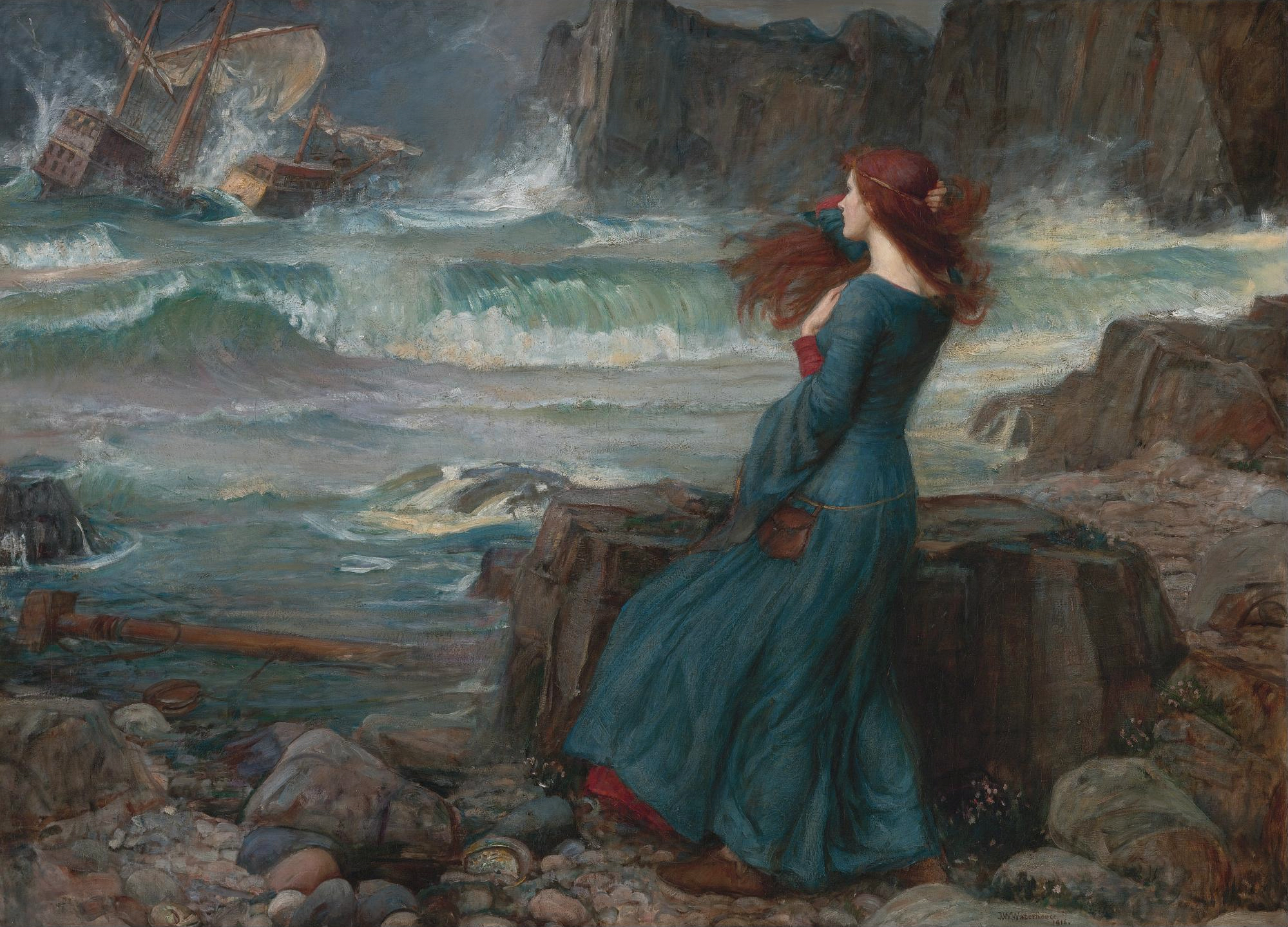
The only female character – Miranda

Very often one of the main issues of “The Tempest” is considered to be colonialism. However, it is easy to see that the image of Miranda, the only female character present in the play, also represents an oppressed figure. In this case the oppression comes from the male dominant society, mostly from her father Prospero, of course.

Miranda is, obviously, a subordinate figure. She obeys everything that her father tells her to do, even if she does not agree (she did not want Ferdinand to be imprisoned; she wanted to talk to him, etc.). She is also represented as a very naive character. She believes everything Prospero says and throughout the play she is not given any opportunity to think or act for herself. She has only seen the world through her father’s eyes. Prospero, on the contrary, looks as a powerful ruler: he uses his physical, magical and rhetoric power to control everyone on the island, including his own daughter.

Miranda is so innocent that we can pardon her when she open-heartedly confesses her love for Ferdinand and asks him to marry her. She even insists on it, and this can be seen a transitory moment when the duty of servitude to your beloved passes from a man (Ferdinand had to serve Prospero thus serving his lady) to a woman.

I am your wife, if you will marry me.
If not, I’ll die your maid. To be your fellow
You may deny me, but I’ll be your servant
Whether you will or no.

(A, 3.1.1333–1336. From now on I will use this text as a reference for the quotations)

This passage speaks of Miranda’s innocence at bluntly stating her desires. She is not used to being in the company of men and thus she does not know social rules of behaviour. She does what she thinks is proper. So, on the one hand, her naivety gives her some sort of independence to manage her relationship as she wants. But, on the other hand, what she thinks is proper is, again, a convention of Elizabethan society. What she wants is to become “a slave” of her husband. She cannot even imagine another way of arranging her marital life (though she could have had some fresh ideas as she has not been raised among people of her epoch). Instead, she deliberately hands all the power over herself to Ferdinand.

Discussing virginity

In Act 4, Scene 1 we see how Prospero finally “presents” Ferdinand with his daughter: “I ratify this my rich gift” (4.1.1659) and gives his blessing to their marriage. He only asks his future son-in-law to take care not to break Miranda’s “virgin-knot” before the wedding has been solemnized. This seemingly coarse discussion of Miranda’s virginity at the beginning of the act makes us think about different issues. First of all, we can notice that this is, practically, the only thing Miranda has been supposed to do during her life – to keep her chastity. It seems to be the most important element of an Elizabethan woman’s education: she does not have to be either intelligent, or beautiful, or strong, or kind-hearted – she only has to be chaste and obedient. And if the latter can be easily improved by some means or the other (as we have seen in the “Taming of the Shrew”, for example), the former once lost cannot be repaired.

Another idea that comes to mind after reading this scene is the fact that even such a private issue as losing virginity is also controlled by men and can be easily discussed by a woman’s father and husband.

Maybe the reader can also think about the fact that Miranda has not got a mother, so most likely she does not know anything that is awaiting her in marriage. Prospero has kept his daughter in total innocence, but the situation is going to change when she marries. She will imminently loose her chastity and thus, her naivety. Probably this worries Prospero, because apart from the fact that from this moment on his beloved daughter will belong to another man, she will no longer stay as naive as before, and she will no longer blindly believe in everything he tells her. In this way, Prospero inevitably is going to lose his power over her, and this is what no Elizabethan man wants – to lose his power over a woman.

The masque

Another interesting episode is the masque that follows this discussion about sexuality. This little entertainment brings the question of marriage into safer realms of society and family. Prospero’s masque features Juno, the symbol of marriage and family life in Roman mythology, and Ceres, the symbol of agriculture, and thus of nature, growth, prosperity, and rebirth, all notions intimately connected to marriage. The united blessing of the union by Juno and Ceres is a blessing on the couple that wishes them prosperity and wealth while explicitly tying their marriage to notions of social propriety (Juno wishes them “honour”) and harmony with the Earth. In this way, matrimony is subtly glorified as both the foundation of society and as part of the natural order of things.

However, while Juno and Ceres focus on the place of matrimony in society and nature, they completely erase the role of love and sexuality in marital life. When Ceres wonders where Venus and Cupid, the gods of love and sex, are, he hopes not to see them because their lustful powers caused Pluto, god of the underworld, to kidnap Persephone, Ceres’s daughter. Iris assures Ceres that Venus and Cupid are nowhere in sight. Venus and Cupid had hoped to foil the purity of the impending union, “but in vain” (4.1.1757). Ceres, Juno, and Iris have kept the gods of lust at bay. It seems that, through his masque, Prospero is trying to suppress entirely any desire of intimacy between Ferdinand and Miranda before marriage. Besides, it shows the true place of love and sex in marriage at that time. They were not only unimportant but they were even unwanted as conjugal union is a mere social construct, not a romantic one.

So, in this play, as well as in nearly all Shakespeare’s comedies, marriage is used as a symbol of a harmonious and healthy social order. Miranda, a subjugated daughter, passes from her father’s hands to her husband’s, sincerely willing to be his “servant” till the end of her life.

TWELFTH NIGHT

“Twelfth Night” was written about seven years later than “A Midsummer Night’s Dream”, so if there has been any change in Shakespeare’s vision of society and gender roles in it, it will be easy to see it in this “mature” comedy.

The image of independent women

Indeed, “Twelfth Night” seems to be different in comparison with other comedies we have analysed before. Here we do not see any typical women closed in their households by their husbands or fathers. Actually, in this play we have the image of strong, self-sufficient women: Viola and Olivia. Both of them are not married, they do not have fathers, and their only brothers have recently died. So, theoretically, they can be the mistresses of themselves and do whatever they want. Shakespeare seems to be interested in investigation of this very topic: what a woman would do if she had temporal or permanent liberty.

However, we see that these two female characters do not take advantage of their free state, either because they do not know what to do with it, or, most likely, because they cannot do much in any case. The only heiress to her father’s estate now that her brother is dead, Olivia is financially independent, but she is vulnerable to unwanted courtship. Being the mistress of her own household, she prefers to cloister herself. Viola, however, is literally homeless. Shipwrecked on the shores of Illyria, she has no house to hide in. Believing her own brother dead, and knowing her wealth makes her a handsome target for men, Viola finds herself with a little too much liberty. No sooner, in fact, is she at liberty than she securely houses herself, not in Olivia’s household, where she cannot gain entrance, but in the guise of a eunuch, thus closing off all possibility of seduction. So, we see that being theoretically independent, these women could not use their liberty, because still they were not totally free in the male dominant society.

Orsino and Viola by Frederick Richard PickersgillViola

Viola, however, seems to have more liberty that Olivia. She disguises as a man and thus she becomes one of them who actually rule in society. She cannot be subjugated and enclosed in her house with domestic affairs. She is free to do and to go wherever she pleases. So Viola becomes Orsino’s servant (by the way, the fact that Viola knows how to play musical instruments, sing and speak poetically speaks about the typical Elizabethan education given to the girls at that time). She falls in love with Orsino, and wishes to tell him about her feelings, though she knows that in her present situation and with a male disguise it is not possible. Anyway, in Act 2, Scene 4, when they are left alone with Orsino, Viola tries to hint at her feelings:

DUKE ORSINO

Thou dost speak masterly:
My life upon’t, young though thou art, thine eye
Hath stay’d upon some favour that it loves:
Hath it not, boy?

VIOLA

A little, by your favour.

DUKE ORSINO

What kind of woman is’t?

VIOLA

Of your complexion.

DUKE ORSINO

She is not worth thee, then. What years, i’ faith?

VIOLA

About your years, my lord.

DUKE ORSINO

Too old by heaven: let still the woman take
An elder than herself: so wears she to him,
So sways she level in her husband’s heart:
For, boy, however we do praise ourselves,
Our fancies are more giddy and unfirm,
More longing, wavering, sooner lost and worn,
Than women’s are.

VIOLA

I think it well, my lord.

DUKE ORSINO

Then let thy love be younger than thyself,
Or thy affection cannot hold the bent;
For women are as roses, whose fair flower
Being once display’d, doth fall that very hour.

VIOLA

And so they are: alas, that they are so;
To die, even when they to perfection grow!

(A, 2.4.907-929. From now on I will use this text as a reference for the quotations)

Besides, from their dialogue we can derive some typical conventions of the time concerning marriage (that are likely to survive to nowadays in some societies): a wife must be younger than husband. There are two main reasons for it: first of all, as Orsino mentions, the man’s fancies “are more giddy and unfirm”, so he is likely to fall out of love soon if he is younger than his wife; and secondly, “women are as roses”, they fade quickly, so if a woman is already older than a man, she will become an old lady very soon, and all men want to have a young and beautiful wife.

Men and women exchanging roles?

In general, Orsino in “Twelfth Night” does not look like a typical misogynist man who wants to be the master of his wife’s body and soul. He is rather passively romantic. Viola and Olivia seem to take the role of men in this case. Sometimes it seems that in this comedy men and women exchange their social roles: men just lament over their romantic sufferings and women woo men. If Viola does it by masked hints, Olivia is not afraid to “hunt” a man she is in love with openly. She is the most “advanced” feminine character in the play, she does not only choose a man to be with, but she also courts him.

Olivia as the most advanced feminine character

“A classic example of a female character that Shakespeare has given license to “act outside her role” as a woman (at least, until she is “appropriately” reined in at the end of the play) is the lady Olivia of “Twelfth Night”. When she falls in love with Viola disguised as the young page Cesario, she works hard to try to woo him, taking on the role of the hunter where she would normally be the hunted. This gives her incredible appeal as a strong and empowered woman, as does the fact that she has no real reason to reject the advances of the Duke Orsino –  in fact she even admits that he’s quite handsome, saying that he is “of great estate, of fresh and stainless youth”; (1.5.551) as well as “in dimension and the shape of nature / A gracious person” (1.5.553-554) but like Hermia of “A Midsummer Night’s Dream” when faced with the love of Demetrius, Olivia refuses to back down and submit to the man she doesn’t want. She is strong, and she rules over her household with an unquestioned hand, with servants at her beck and call and even her live-in uncle (an older, male relative, who by all accounts should be in charge) firmly under her thumb. Even while the strong, shipwreck surviving Viola, or the wise and dangerous lady Portia of “Merchant of Venice” are forced to go into disguise in order to protect themselves as they wade in among the dangers of the male world, Olivia steps forth undisguised and unchallenged, as firm against the tide of the misogynistic elements of society as the Elizabethan era’s own “Virgin Queen” was. Like Shakespeare’s Olivia, Elizabeth too stood as a pinnacle of female power, refusing all suitors as she sat at the helm of her nation (not just her household) with control over many older males, including members of the clergy and the military, unwilling to yield her power to any would-be king.

In the end however, despite all of Olivia’s power and feminine flame, despite all her similarities to the “Virgin Queen” who never fell to the wiles of suitors or ambitious men, the Lady of Illyria is easily undone, and her end is perhaps fitting for the eyes of an audience of Shakespeare’s era, reducing her to a mewling kitten-like shadow of her former self, one who cries out “What shall you ask of me that I’ll deny” (3.4 1728) in the hopes of winning the love she now desperately seeks to see returned (instead of valiantly denying or hunting it.) It takes only the easy agreement of Viola’s brother Sebastian (who Olivia doesn’t really know at all when it comes right down to it) to reign her in and put her under the knuckles of male domination (where members of the audience at that time in history would probably argue she truly should be) as the wife of a penniless “gentleman” who is most certainly beneath her. Whether this is a veiled critique, stab, or worse– hope for the future inserted by Shakespeare in regards to the “Virgin Queen” and her refusal to marry, we can only guess, though I still think it bears mentioning as something to consider when we read “Twelfth Night” and witness first hand the way the mighty Olivia is brought low by a young man who, like so much refuse and dead seaweed, was found and brought into the city by an enemy of the ruling elite after he washed up on the shore of Illyria.”(E)

Thus, again we see that the original image of independent women, mistresses of themselves, vanishes at the end of the play. The idea of harmony in androcentric society emerges instead, making us feel that this is what the women in “Twelfth Night” were, actually, looking for, as now they are perfectly happy and peaceful.

A MIDSUMMER NIGHT’S DREAM

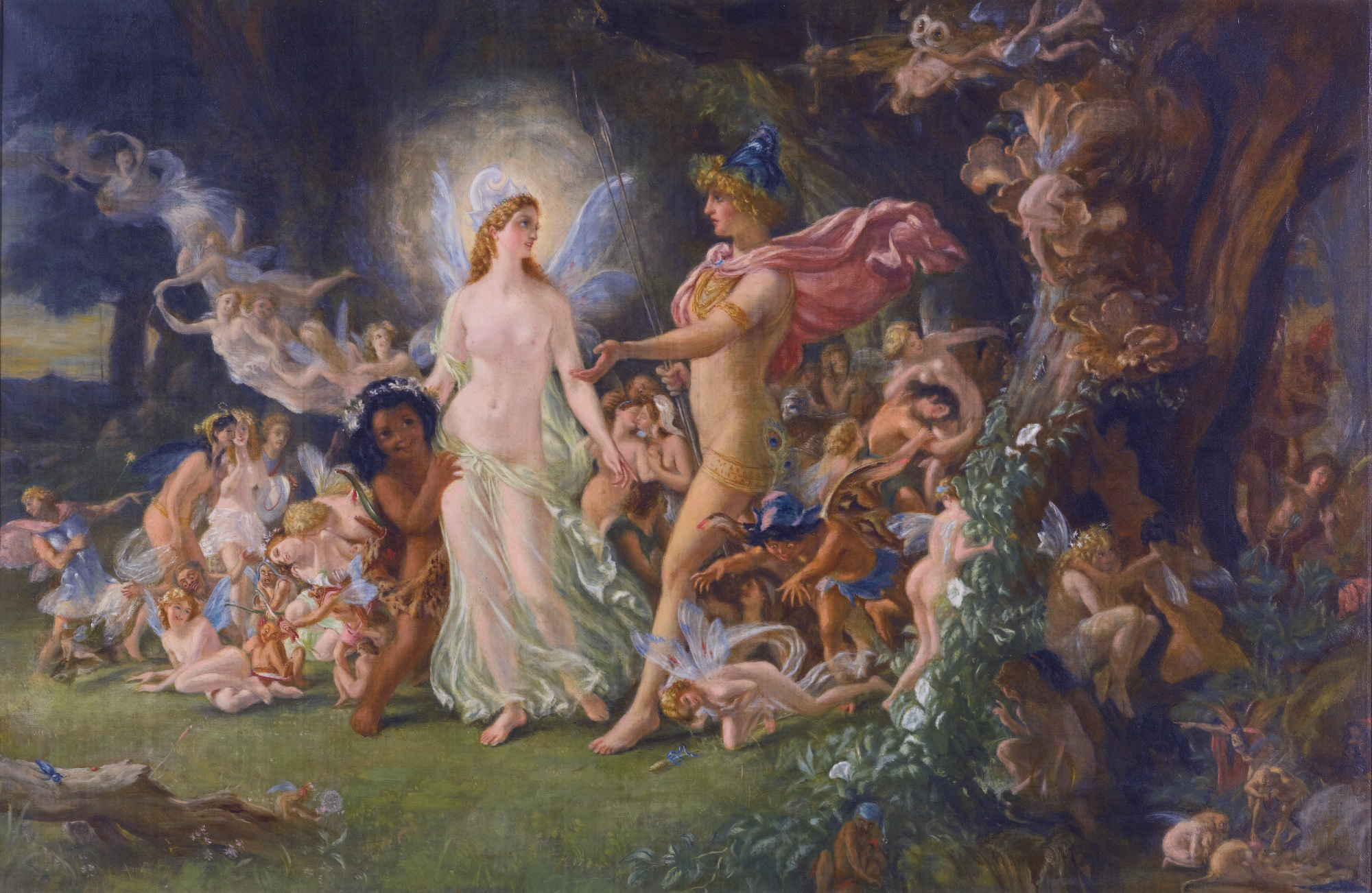
Study for The Quarrel of Oberon and Titania. Sir Joseph Noel Paton

“A Midsummer Night’s Dream” is a very interesting play to look at when we speak about the position of men and women in Elizabethan times. It is full of examples of the rules of the patriarchal society in which Shakespeare lived and worked.

Theseus and Hippolyta

The comedy starts with the wedding ceremony between Duke Theseus and Hippolyta, Amazonian queen. It is already unusual that the author presents strong female characters in his play, Hippolyta being the most extreme case as she is the Queen of the Amazons. It is different from what we have seen before in “The Comedy of Errors” and “The Taming of the Shrew”. Is Shakespeare going to change his vision of ideal patriarchal way of living?

The fact that Hippolyta stands up to Theseus when she disagrees with him in Act V is extremely significant. In Shakespeare’s time, the wife had to be the submissive, silent partner in a relationship. Hippolyta’s role in her relationship with Theseus is indeed striking. However, the following analysis of this vivid couple depends on the reader. On the one hands, we may think that Hippolyta attracts Theseus with her feminine charm which proves to be stronger than her forceful nature. Theseus seems to be totally in love with his bride and by marrying her he is saying “farewell to arms” and is surrendering to Hippolyta’s beauty and love. Thus, the former queen of the Amazons becomes a queen of new realm – Athens.

On the other hand, however, we may interpret everything the other way round. The opening scene of “A Midsummer Night’s Dream” may look like Hippolyta’s subjugation as Theseus reminds his future wife: “Hippolyta, I wooed thee with my sword, / And won thy love, doing thee injuries.” (A, 1.1.20-21. From now on I will use this on-line text as a reference for the quotations). Capturing her when he defeated the Amazons, Theseus abducted Hippolyta from her Amazon sisters to bring her to Athens and marry her. That is why it depends on the director of the play how to present this female character, whether as a willing bride or as a captive that has no other way out but to surrender.

Egeus as a father

Then we are presented with another problem: Egeus wants his daughter Hermia to marry his chosen man, Dimetrius, though she loves Lysander. To persuade her, Egeus invokes Athenian law, which offers her one of two alternatives: death or life as a nun.

But Egeus’s vision is not reasonable or even remotely justifiable. In insisting on Demetrius as a husband, Egeus insists on a young Athenian who is to all intents and purposes indistinguishable from Hermia’s choice, Lysander. Demetrius is from the same background as Lysander, as rich as Lysander, and as handsome. Egeus, therefore, has no logical reason for preferring Demetrius. Apart from the idea that Egeus had a special homosexual affection towards Demetrius, there is an interesting opinion about that irrationality, expressed by Shirley Nelson Garner (C). Egeus, knowing that Demetrius is likely to be an unfaithful husband to his daughter (because he has already proved himself to be unreliable by wooing Helena and then leaving her), intentionally chooses badly for his daughter, because he wishes to keep her for himself. By insisting that she marry a man whom she does not love and one who may be disloyal to her besides, Egeus assures that Hermia will always love her father and that she will never really leave him. Whatever Egeus’s reason may be, he uses his power as a father to make his daughter comply with his wish. As we have seen, for this purpose there was even a special law for disobedient daughters.

Though Theseus is less severe than Egeus, he is, from the outset, unsympathetic toward women. He utterly supports Egeus as patriarch, telling Hermia:

To you your father should be as a god,

One that composed your beauties; yea, and one

To whom you are but as a form in wax

By him imprinted and within his power

To leave the figure or disfigure it. (1.1.55-59)

As a ruler, he will enforce the law, which gives Egeus control over Hermia’s sexuality and embodies patriarchal order.

Hermia and Helena as a possible threat to the patriarchal society

But what happens next? Hermia still does not want to obey, and she does not want to be neither nun nor cadaver, so she decides to run away with Lysander, to escape the society that does not give her any chance to build her life as she wants. She is joined by Helena, and together they might have achieved more results in protesting against the patriarchal bondage; however Shakespeare does not allow them to undermine the existent order of life, so the two women quarrel and finally separate. Once their friendship, and thus their power, is diminished, both of them are presumably “ready” for marriage.

This feminine “break-out” will end up in returning to the starting point. As this is a comedy, the girls will not be punished for their disobedience. Everything will turn out right and the initial disorder will end in harmony. The cost of it, however, is the restoration of the patriarchal hierarchy, so threatened at the beginning of the play. In the end, both Hermia and Helena marry their chosen men, in this way perpetuating the “circulus vituosus”: the process of marrying is how power over a woman changes hands from father to husband. Originally submissive daughters become submissive wives. Puck’s verse, in this respect, provides the paradigm:

Jack shall have Jill;

Nought shall go ill;

The man shall have his mare again,

And all shall be well.

Oberon and Titania

There is another example of the marital relations, it is that one of Oberon and Titania. They are both supernatural characters, the King and the Queen of the Fairies. In the beginning they seem to have equal magical powers, but later Oberon’s power proves to be greater. They quarrel about the possession of an Indian boy that Titania loves so much, and this quarrel brings chaos to the natural world.

Oberon’s determination to have the child for himself suggests that he is jealous of him. He wants to have the exclusive love of his wife, Titania. His official reason, however, is that he wants the child to be his “henchman”, and it may seem reasonable since there was a practice of taking boys from the nursery to the father’s realm so that they can acquire the character and skills appropriate to manhood. But there is no suggestion that Oberon wants to groom the child for manhood. Besides, for this purpose he could have returned the boy to his father, with whom he, as a human child, might be most probably reared.

So, the child poses a threat to the King of Fairies who needs Titania all for himself. And since Oberon cannot persuade his wife to turn the boy over to him, he will use his power to humiliate and torment her until she does so. He uses the love potion not simply to divert her attention from the child, so that he can have him, but to punish her as well. When Puck tells him that Titania is “with a monster in loue” (3.2.1028), he is obviously pleased and thinks that the situation turned out better than he had expected.

Titania and Bottom

Though the scenes between Titania and Bottom are charming and hilarious, Titania is made ridiculous. Whereas her opening speech is remarkable for its lyric beauty, and her defense of keeping the Indian boy has quiet and dignified emotion power, now she is reduced to admiring Bottom’s truisms and his monstrous shape: “Thou art as wise as thou art beautiful” (3.1.965).

Besides, there is the following argument presented by Sarah Carter in her work about “A Midsummer Night’s Dream” (D):

“Titania’s links to the classical multiple-formed goddesses can be widened. It was, and is, common for trans-culturally equated and inter-culturally related goddesses to be made composite, and for ancient mother goddesses such as Isis to be assimilated into various cultures. Frances A. Yates records that Astraea is a composite of or comparable to Ceres (Astraea holds a sheaf of corn), Venus, Fortune, Isis, Atargatis, the Syrian goddess worshipped under the name of Virgo Caelestis at Carthage, and is associated with Urania, and, like Isis, with the moon.[16] The ancient great goddess Isis, of whom Apuleius becomes a devotee in The Golden Ass, is further disseminated into Artemis, Aphrodite, Proserpine, Ceres, Juno, Bellona and Hecate through younger and foreign civilisations.[17] This amalgamation resulted in what Ted Hughes terms in his pervasive study the ‘Great Goddess’ or the ‘Goddess of Complete Being’.[18][19] the destruction of the Goddess’ beloved by his brother god, and the destruction of the Goddess herself by the same […] Hughes’ vast thesis is that three fundamental myths establish the belief systems and mythology of multitudinous cultures, mainly ancient European, Middle Eastern and Northern African. These myths are the existence of the Great Goddess (in most obvious and ancient form the Earth mother type goddesses of Rhea, Gaia, Tiamat and Isis)

[…] it is easy to read the conflict between Titania and Oberon as a relatively straightforward representation of the destruction of the Great Goddess, the misogynistic myth and anxiety underpinning ancient patriarchal belief systems. Hughes writes that Oberon’s revenge is ‘a grotesque fairyland nightmare’, in that he makes Titania ‘wholly a Queen of Hell … As a result she is revealed as the consort of the Lord of Hell – who is always the gross inferior brother, Set, who is the Boar, or alternatively (in Egyptian terms) the Ass.’[20] Significantly, Set had ass’ ears and the ass was his sacred animal. For this reason, asses were said to be hated by Isis, and sacrificed prolifically in honour of Horus, the avenging son of Osiris and Isis.[21] Thereby, Bottom’s ass head represents the animal that the moon goddess Isis describes in The Golden Ass as ‘the most hateful beast in the universe’.[22] One of the Great Goddess’ manifest forms was as Divine Love,[23] which leads us back to the Neoplatonic communion between the divine and the human of Titania and Bottom, and yet also the corresponding utter humiliation of a goddess figure in a union with a detested creature.” So, the union between Titania and Bottom (an ass) seems to be a double humiliation for the Queen of Fairies.

Oberon’s winning the boy from Titania is at the centre of the play, for his victory is the price of amity between them, which in turn restores the green world.

We see that on all the levels, even on the supernatural one, patriarchal system is present, and moreover, it proves to be more powerful and harmonious. The male dominance is always re-established, even if it was undermined in the beginning, and this brings perfect accord, love and happiness to everyone. This is how things should be in a normal Elizabethan society.
THE COMEDY OF ERRORS

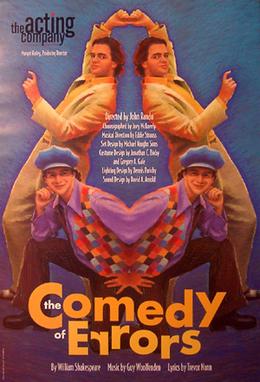
Theatrical poster of The Acting Company production of The Comedy of Errors. Designed by Scott McKowen.“The Comedy of Errors”, as well as “The Taming of the Shrew”, belongs to the early period of Shakespeare’s writing, that is why it is easy to notice a lot of common ideas manifested by the author in both plays. The two comedies devise farcical settings for the expression of Elizabethan principles requiring a wife to subjugate to her husband: in “The Comedy of Errors” they are stated by Luciana and (less directly) by the Abbess, and in “The Taming of the Shrew” by Katherina in her final speech.

Men in “The Comedy of Errors”

To start the analysis, let us look at the description of the life of the main characters. Not much is said about their background and home education, but all of the principal heroes belong to noble class, so they must have received a proper education for their social position. We see that both Antipholi are literate and educated, as men were supposed to be at that time. It is noticeable in their correct speech and behaviour. Antipholus of Ephesus has a rich house with servants and he is married. He is the master of his household and behaves like one (according to the conventions of the time it could not be otherwise). When he feels that his authority is in danger he becomes furious (the episode when he is not allowed to enter his own house shows that he can be violent, ready to smash down a door and beat his wife to restore his damaged reputation of the real master of the house).  We do not see him with any occupation, however, except drinking in the company of friends. Later on, as he is his own boss and free to do whatever he wants, Antipholus of Ephesus is ready to seek comfort from a woman who is not his wife, and he does not seem to feel any remorse. Moreover, the reader can get a sensation (especially after the Abbess’s speech) that he was right to do so, because if a man is not welcomed in his own house he has to find another house where he can be warmly received.

As for Antipholus of Syracuse, we see that he looks quiet and despondent in comparison with his brother. When not harassed, he is gentle and courtly, given to calling ladies “fair dame” or “gentle mistress”, and he is eloquent in his wooing. However, he has a quick temper – at the contrariness of servants he easily flares into anger and strikes blows. That fact makes me think that men were likely to be gentle and soft with women in the process of wooing, but they showed their real masculine nature later on in marital life.

Women in the play

The women of the play, as it is common for Shakespearian comedies, occupy a more important role and stand out more vividly than the men.

From the very beginning we see the two main female characters, Adriana and Luciana, in the circumstances typical for the women at that time – at home, waiting for Adriana’s husband (the master of the house) to come to have dinner. Throughout the play they do not seem to have any other occupation than managing the household, thinking about meal, taking care of children, etc. The characters of “The Comedy of Errors” live in a normal patriarchal society.

Again, it is easy to notice some resemblance with “The Taming of the Shrew”: Adriana is not presented as a passive, submissive wife but rather as a shrew. She is indignant at her husband’s behaviour and she claims her right to have a loving spouse and a warm hearth. This may be normal and sensible nowadays, but in Elizabethan times a woman had to be resigned to her husband in all the ways, she could not demand anything from him. That is why we can feel that Adriana’s behaviour will have to be improved; she will have to be “tamed”.

Indeed, finally Adriana is “tamed”, but not by her husband as in “The Taming of the Shrew” (however, there is a possibility of that when Antipholus of Ephesus asks his Dromio do find a rope with which he is planning to beat Adriana) but she is “enlightened” by other women in the comedy, Luciana and the Abbess, that are portrayed as wise and intelligent.

Luciana is somewhat given to preaching and never loses her chance to instruct her elder sister as how to be a good wife. The Abbess is “a virtuous and a reverend lady”, a splendid figure, a woman of great authority (by the way, it is interesting to notice that the Abbess was a wife in the past, but having lost her family she could do nothing else but become a “nun”; the society did not provide her with other opportunities: a woman is either a wife or a nun). She has no patience with nagging wives and tells them so; Adriana has to put up with a severe scolding from her. Both Luciana and the Abbess use St Paul’s Epistle to the Ephesians to respond to Adriana’s complains about her husband’s apparent misbehavior and indifference to her. St Paul’s admonition beginning “Wiues, submit your selues vnto your owne husbands, as vnto the Lord”, is directly echoed by Luciana (1, 2.1.6-24, for example. From now on I will use this text as a reference for the quotations), and less directly by the Abbess (5.1.68-86): men are “masters to their females, and their lords”; in all his pursuits “to be disturbed, would mad or man or beast”. Both Luciana and the Abbess try to teach Adriana a social norm of being a submissive and obedient wife, because this is the only guarantee of marital happiness. Of course, the reader cannot know what has happened before the present events and how the conjugal life of Adriana and Antipholus of Ephesus has been until the present moment, but the fact that Antipholus frequents his lover’s house and spends most of his time drinking does not seem to be correct and easily explainable. That is why the Abbess’s words about Adriana’s jealousy (“The venom clamours of a jealous woman poisons more deadly than a mad dog’s tooth”) do not sound appropriate. Adriana is jealous because she has a reason for it, but the other two women close their eyes to it, putting all the blame on Adriana. They probably know that it is easier to put up with your husband’s “whims” than try to change him, because this is what a good wife should do – submit to her “lord”.

A woman’s duality in “The Comedy of Errors”

However, it is not so easy to divide Adriana and Luciana into a shrew and an obedient wife. Both of them have the traits of the other character.

It may seem sometimes that Adriana behaves so “shrewishly” because she tries to please her husband not only in a spiritual way but also in sexual, but cannot achieve it. It is not a secret (in Elizabethan times as well) that a wife, apart from a moral duty has a sexual duty to her spouse. Adriana attempts to unite both extremes, attending to her husband’s body and soul: she offers private dinner (a euphemism for sex) and confession (“Husband, I’ll dine above with you to-day, and shrive you of a thousand idle pranks”; 2.2.207-208). Adriana sees her identity as a wife as a fusion of two opposing female stereotypes.

That brings us to the two polar images of a woman: independent pagan Amazon (some sort of demonic female who wants to possess the male) and submissive Christian servant (whom a man possesses). At the beginning of the play Adriana is clearly equated with the Amazon type, Luciana with the Christian. The former chafes at the restrictions marriage imposes on women (“Why should their liberty than ours be more?”; 2.1.10), the latter knows St Paul’s lesson about a man being the master of his wife.

Having introduced this opposition the play immediately begins to question it. Adriana can hardly be an independent woman since, as a wife, she has legally promised submission, while Luciana, who preaches submission, can do so only because (as Adriana points out) she is independent (2.1.38-41). The identities of the two sisters, like those of the twins, begin to merge, become confused. “Despite her rhetorical question “Why should their liberty than ours be more?”, Adriana seems to want not liberty but the right to love and be loved as a wife. When next we meet the women it is Adriana who has the long Pauline speech on marriage as she lyrically, passionately tells Antipholus that husband and wife are “undividable incorporate” (2.2.122; cf. Ephesians 5:31). Luciana’s subsequent speech on marriage is strangely unspiritual, full of knowing advice to her (supposed) brother-in-law about how to conduct an extramarital affair: “Look sweet, speak fair, become disloyalty; / Apparel vice like virtue’s harbinger; / Bear a fair presence, though your heart be tainted; / Teach sin the carriage of a holy saint: / Be secret-false” (3.2.11-15). Throughout “Errors” we see Adriana and Luciana trying to work out which type of Ephesian woman to be (pagan or Christian, independent or submissive), and experimenting with whether it is possible to be both.” (2, p. 73)

So, maybe, even though the general tone of “The Comedy of Errors” is that one supportive of the patriarchal society, Shakespeare wanted to introduce a subtle idea of the existence of a woman’s independent, passionate, sexual, a little devilish side. He insinuates that to be a good wife a female must possess some other qualities, apart from submissiveness, and an ideal wife will know how to unite her Amazon and Christian selves.

It seems that in the previous work I have concentrated mainly on the education of men and women from the noble classes, however in Shakespearian comedies we frequently see people from low walks of life. As far as the poor men are concerned, the thing is more or less clear: they usually obtained some practical skills that permitted them to work and earn their bread or they became the servants and companion of the master of the house (as Dromio in “The Comedy of Errors”). Nothing was considered wrong about that.

But what did the women from the low class do? John Fitzherbert (A Book of Husbandry, 1525) offers this advice:
“When thou art up and ready, then first sweep thy house, dress up thy dish-board, and set all things in good order within thy house; milk thy kine [cows], feed thy calves, sile [strain] up thy milk, take up thy children and array them, and provide for thy husband’s breakfast, dinner, supper, and for thy children and servants, and take thy part with them.

And to ordain [organize] corn and malt to the mill, to bake and brew withal when need is. . . Thou must make butter and cheese when thou may; serve thy swine, both morning and evening, and give thy pullen [fowl] meat in the morning, and when time of the year cometh, thou must take heed how thy hen, ducks and geese do lay, and to gather up their eggs; and when they wax broody to set them thereas no beasts, swine or other vermin hurt them. . .

And in the beginning of March, or a little before, is time for a wife to make her garden. . . And also in March is time to sow flax and hemp. . . and thereof may thou make sheets, board-cloths [table- cloths], towels, shirts, smocks, and such other necessaries; and therefore let thy distaff be always ready for a pastime, that thou be not idle. . .
(The distaff was the stave on which wool or other raw fibre was placed, so that it could be spun by hand.)” ¹

So, we can see that poor women had to work hard to provide for the family and to keep the household in good order.
But what if a person did not have a household? What duties did he/she perform then?

Masterless men and masterless women
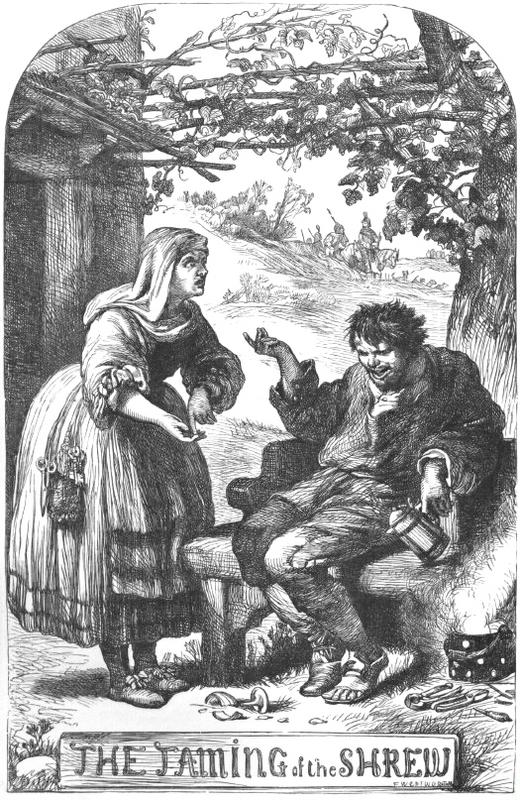
Christopher Sly and the Hostess from the Induction of The Taming of the ShrewIn “The Taming of the Shrew” for example, there are characters that represent both poor men and poor women. Remarkably, these characters break the norm of the society where men are superior and women are submissive. It seems that the poor live according to their own rules, the main one being “The strongest survives”, and sometimes a woman can be “the strongest”.

Sly is just at the bottom of the social ladder, he does not have an occupation with which he could earn his living (so marriage in this situation is out of the question, he is not able to perform his duties as a husband), and he does not have a master to serve either. He is a “masterless man”, a legal term for the criminality unemployed in early modern England –those men who were literally without masters and also without a household. In modern terms they were the homeless poor. Living below the economic level necessary for marrying, and not legally bound to a master or marital household, masterless men like Sly slipped from household to household, employment to employment, ending up as Sly has done in the opening scene, in the street. Interestingly, his drama is the drama of Marian and Cicely Hacket, two feminine characters who are apparently masterless themselves. Both of them practice housewifery in an alehouse – not a respectable occupation, but one associated with prostitution.

“Marian and Cicely Hacket exceed the subject position of maid, wife, and widow. Marian is a wife, but she is an alewife, a term for an occupational, not a marital, status: she sells ale. Cicely is the “maid of the house”, also an occupational term. Not a marriage manual virgin, she is instead the kind of maid whom Sly calls out for in his sleep. Neither woman fits easily into the marriage and husbandry manual ideal of the mastered household. Both live in the house, but in an alehouse. Marian seems to master her own house without the help of a husband. The women do perform housewifery, as in household management, financial transactions, baking and brewing – the kinds of activities that conduct books instructed orderly housewives to do. But this household is disorderly. If Sly’s account is anything to go by, this household is crosscut by drinking, sexual activity outside of marriage, overnight lodgers, arguments over bar bills, and criminal enterprise, such as selling ale in short measure. In the opening moments of the play, an alewife ejects Sly from her alehouse, threatening to fetch the constable. In this Induction to the play, Shakespeare writes a miniature drama in which poor women cannot be tamed into orderly wives but rather remain fiercely untamed shrews. The wandering players in the Induction put on a play about “household stuffe”, but the entire drama that Shakespeare’s company performs begins with a masterless man being expelled from a disorderly household by a masterless woman.” (3, pages 2-3)

So we see that men and women without a master and/or a household made a living in streets, fields, markets, taverns and alehouses. And this poor world has its own rules, sometimes opposite to those ones of the well-to-do families. Here women are strong and cannot be “tamed” or subject to any man because their hard life has taught them to fight. Their self-sufficiency is the secret of their survival.

Kitchen vestals
The attitude towards poor women and their occupations is usually coarse, and it can be noticed even in the language used to refer to such women. As with kitchen wench and “behind-door-work”, some terms for poor women derived from particular spaces of the household. Words like “kitchen-stuff”, which simply meant “grease”, made the occupation of kitchen wench everywhere in early modern drama signal detestable feminine sexuality at the bottom. Improvisations on “greasy” feminine sexuality occur in even more abstruse and contradictory formulations. In “The Comedy of Errors”, for example, Dromio of Ephesus refers to a kitchen maid as a “kitchen vestal”, deriding the unpursued virginity of kitchen maids (1, 4.4.76) and hinting at the fact that these women are also some kind of household prostitutes.

Free maids
However, poor women are nearly always present in early modern drama. In “Twelfth Night” there is a subtle contrast between Olivia, a well-dowried maid, and poor maids who lack dowry and are positioned at the other end of the social scale. Longing for Olivia, Orsino wants a song to reflect his mood:
O, fellow, come, the song we had last night.
Mark it, Cesario, it is old and plain.
The spinsters and the knitters in the sun
And the free maids that weave their threads with bones
Do use to chant it.

(A, 2.4.931-935. From now on I will use this on-line text as a reference for the quotations)

Orsino conjures up the image of maidens sitting in the sun practicing housewifery as a kind of antique history of femininity recovered from the lost age of courtship.

These maids make their appearance only in a song. Such songs in Shakespeare remain unexamined, often because literary historians, among them George Orwell, consider them “nonsense songs” with nothing to reveal. But they are, in fact, what music historians and folklorists call “occupational songs” – songs sung while working. They are also motion songs performed to maintain the rhythm of physical motion – the motion of knitting, spinning and weaving lace.
The “free maids” Orsino refers to are not “carefree” maids as some may think, but they are maids living outside the bondage of a domestic service contract. They are impoverished workers losing their health to the mechanized labor and pauper wages of lace-making.

The assumption that women divided easily into maids, wives and widows does not allow for the vast distinctions between a rich maid like Countess Olivia, for example, and a poor maid like Orsino’s lace maker. Actually, “Twelfth Night” is an interesting play because in it Shakespeare offers us various maids in relation to the household, and none is a typical maid seen in “The Taming of the Shrew”. Olivia, sole heiress to her father’s estate now that her brother has died, owns and masters her own household and its accompanying wealth. Viola arrives shipwrecked on the shores of Illyria, with her brother dead too, but without a household. She uses male disguise and attaches herself as soon as possible to a household for protection. The only working maid in the play is Maria, a “gentlewoman maidservant” bound to Olivia’s household who can move freely between the two aristocratic households and converse freely with all the men in Olivia’s house – servants and knights alike. She may be a reminiscence of the free maids, yet she is a daughter of the gentry. She has neither inheritance nor dowry and must work for a living.

So, by writing this chapter I wanted to expand the outlook on the topic about education of men and women in Elizabethan society. Of course, the ideal image of both sexes was strongly connected with a marital life and a household, and the duties that each sex had to perform in it. But very often the needs of life and the social status of a person dictated their own conditions. That is why many poor women, as well as poor men, had to acquire some practical skills to be able to work and earn money. When those people did not have a master to serve or a marital household, their poverty could lead them to have occupations close to criminal ones. A man could become a drunkard and a beggar. The image of a woman in this case changes dramatically: now it is her who rules her own house and controls her own life. Moreover, she can be superior to a man, socially and economically, as we have seen in the Induction to “The Taming of the Shrew”. Probably, because of the rebellious image that the poor women often present, they seldom get to speak for themselves, even as boy actors. They are recollected and remembered from somewhere offstage. Poor women are usually the objects of early modern drama, and of early modern bureaucracy, not their agents. They do not fit into the patriarchal society, so they are expelled from it. Yet they are very much the agents of culture – making the thread that runs the wool trade, laundering and washing and feeding and selling, producing and reproducing and improvising culture as they ply their sundry trades.

INTRODUCTION

In this paper, which is a continuation of my previous work (“First Paper”), I am going to proceed with the development of the topic “Education of Men and Women in Elizabethan England”. Now I will see how it evolves and changes (if it evolves and changes at all) in later Shakespearian comedies. For this purpose I have chosen four different plays, written in different periods of time, so that it can be easier to see the evolution of the topic throughout time. Apart from “The Taming of the Shrew”, one of the early comedies by Shakespeare, that was analyzed in the “First Paper”, I have picked out  “The Comedy of Errors” which also belongs to the early period (1592), then “A Midsummer Night’s Dream” written in 1595, “Twelfth Night” (1602) and, finally, “The Tempest” which is the latest Shakespearian comedy (1610-1611). You can easily see that these plays present a chronological sequence with the interval of several years between each two plays. In my opinion, this is the optimal way of tracking the development of Shakespeare’s ideas about due education for men and women: by seeing how he reflects his beliefs in his comedies of different periods.

So, in this paper I will analyze the comedies mentioned before in order to see if the concept of men and women presented by Shakespeare in “The Taming of the Shrew” changes somehow with time (Just to remind you: in “The Taming of the Shrew” the author seems to support the general convention of his society: a woman has to be an obedient wife, has to cherish her husband and take care of the family and the household, while a man has his obligations to provide his family with everything necessary).

I will divide my paper into the following parts: The Comedy of Errors, A Midsummer Night’s Dream, Twelfth Night, The Tempest, Poor People in Shakespearian comedies, and Conclusion. The first four parts correspond to the analysis of the four respective comedies, the next chapter is dedicated to a brief commentary on the position of poor men and women in Elizabethan society and its reflection in several comedies, and in Conclusion I will summarize the ideas and try to see if there is any significant change in Shakespeare’s concept of education of both sexes, if it has evolved through time or not.

CONCLUSION

Of course it is up to the reader to decide what exactly Shakespeare wanted to say in “The Taming of the Shrew”, whether he really approved of the patriarchal state of society where the position of men and women was strictly determined by the male dominance, or whether his idea was to criticize the situation and bring to the surface all the flaws that the repression of women’s rights engendered.

The only thing that we can see clearly is the reflection of the characteristics of Elizabethan times in which the author lived, especially those ones that were connected with the education of men and women. In my part of the work I have analyzed the aspects concerning difference in education of boys and girls and the concept of the wife’s status. From what I have done I can derive a certain conclusion: in Shakespearian time the position of sexes was not equal. It is obvious enough that the boys had the supremacy and all the rights (to study, to travel, to choose whom to marry, to dispose of property and money), while a woman from the very early stage of her life was obliged to serve men and submit to the rigid system where her place had already been predetermined: she had to have some practical knowledge about the household and raising children, because there was no sense (and no opportunity) to study something that could broaden her outlook (because she would not need these attainments in her life and because she was considered to be “weak in the head” anyway, not able to understand anything that was not needlework or giving birth). Even if she was from a rich family and could study music and languages, she would use this knowledge only to entertain her husband by singing or playing some musical instrument when he came home in the evening; again this learning was not for her but for men and their satisfaction.

A woman did not have any right to choose her future husband because marriage was not a romantic “union of hearts” but a financial transaction in which a woman was an article of trade. And if she dared to rebel against that state of things, she would be subjected to the process of taming (which sometimes took extremely violent forms as men did not miss the opportunity to assert themselves and boast about their physical strength), so that in the end she would become “a proper wife”.

No wonder this strong sexist connotation provoked much discussion, especially when the feminist movement gained power and popularity. We cannot be sure that Shakespeare himself approved of that state of affairs but in his play he reflected the society of the time, and now it is the reader’s responsibility to interpret “The Taming of the Shrew” and to draw his own conclusions.

« Newer Posts - Older Posts »