THE TEMPEST
7 diciembre 2010 by KSENIIA
“The Tempest” belongs to Shakespearian latest comedies, written around 1610. It does not look the same as his earlier comedies, it is more a mixture of comedy and romance. However we can analyse it for the purpose of seeing the development of the topic of education of men and women.
The only female character – Miranda
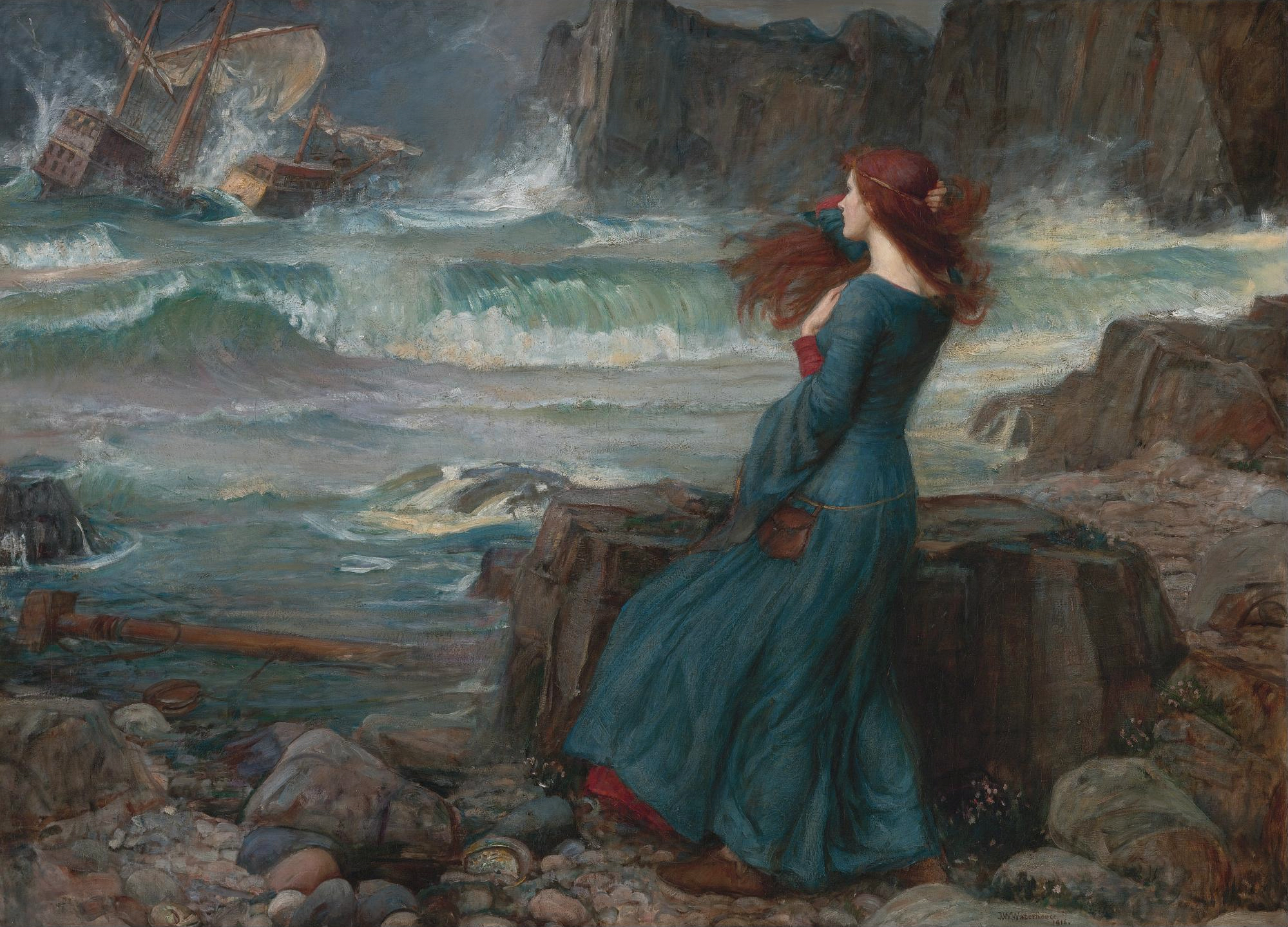 Very often one of the main issues of “The Tempest” is considered to be colonialism. However, it is easy to see that the image of Miranda, the only female character present in the play, also represents an oppressed figure. In this case the oppression comes from the male dominant society, mostly from her father Prospero, of course.
Miranda is, obviously, a subordinate figure. She obeys everything that her father tells her to do, even if she does not agree (she did not want Ferdinand to be imprisoned; she wanted to talk to him, etc.). She is also represented as a very naive character. She believes everything Prospero says and throughout the play she is not given any opportunity to think or act for herself. She has only seen the world through her father’s eyes. Prospero, on the contrary, looks as a powerful ruler: he uses his physical, magical and rhetoric power to control everyone on the island, including his own daughter.
Miranda is so innocent that we can pardon her when she open-heartedly confesses her love for Ferdinand and asks him to marry her. She even insists on it, and this can be seen a transitory moment when the duty of servitude to your beloved passes from a man (Ferdinand had to serve Prospero thus serving his lady) to a woman.
I am your wife, if you will marry me.
If not, I’ll die your maid. To be your fellow
You may deny me, but I’ll be your servant
Whether you will or no.
(A, 3.1.1333–1336. From now on I will use this text as a reference for the quotations)
This passage speaks of Miranda’s innocence at bluntly stating her desires. She is not used to being in the company of men and thus she does not know social rules of behaviour. She does what she thinks is proper. So, on the one hand, her naivety gives her some sort of independence to manage her relationship as she wants. But, on the other hand, what she thinks is proper is, again, a convention of Elizabethan society. What she wants is to become “a slave” of her husband. She cannot even imagine another way of arranging her marital life (though she could have had some fresh ideas as she has not been raised among people of her epoch). Instead, she deliberately hands all the power over herself to Ferdinand.
Discussing virginity
In Act 4, Scene 1 we see how Prospero finally “presents” Ferdinand with his daughter: “I ratify this my rich gift” (4.1.1659) and gives his blessing to their marriage. He only asks his future son-in-law to take care not to break Miranda’s “virgin-knot” before the wedding has been solemnized. This seemingly coarse discussion of Miranda’s virginity at the beginning of the act makes us think about different issues. First of all, we can notice that this is, practically, the only thing Miranda has been supposed to do during her life – to keep her chastity. It seems to be the most important element of an Elizabethan woman’s education: she does not have to be either intelligent, or beautiful, or strong, or kind-hearted – she only has to be chaste and obedient. And if the latter can be easily improved by some means or the other (as we have seen in the “Taming of the Shrew”, for example), the former once lost cannot be repaired.
Another idea that comes to mind after reading this scene is the fact that even such a private issue as losing virginity is also controlled by men and can be easily discussed by a woman’s father and husband.
Maybe the reader can also think about the fact that Miranda has not got a mother, so most likely she does not know anything that is awaiting her in marriage. Prospero has kept his daughter in total innocence, but the situation is going to change when she marries. She will imminently loose her chastity and thus, her naivety. Probably this worries Prospero, because apart from the fact that from this moment on his beloved daughter will belong to another man, she will no longer stay as naive as before, and she will no longer blindly believe in everything he tells her. In this way, Prospero inevitably is going to lose his power over her, and this is what no Elizabethan man wants – to lose his power over a woman.
The masque
Another interesting episode is the masque that follows this discussion about sexuality. This little entertainment brings the question of marriage into safer realms of society and family. Prospero’s masque features Juno, the symbol of marriage and family life in Roman mythology, and Ceres, the symbol of agriculture, and thus of nature, growth, prosperity, and rebirth, all notions intimately connected to marriage. The united blessing of the union by Juno and Ceres is a blessing on the couple that wishes them prosperity and wealth while explicitly tying their marriage to notions of social propriety (Juno wishes them “honour”) and harmony with the Earth. In this way, matrimony is subtly glorified as both the foundation of society and as part of the natural order of things.
However, while Juno and Ceres focus on the place of matrimony in society and nature, they completely erase the role of love and sexuality in marital life. When Ceres wonders where Venus and Cupid, the gods of love and sex, are, he hopes not to see them because their lustful powers caused Pluto, god of the underworld, to kidnap Persephone, Ceres’s daughter. Iris assures Ceres that Venus and Cupid are nowhere in sight. Venus and Cupid had hoped to foil the purity of the impending union, “but in vain” (4.1.1757). Ceres, Juno, and Iris have kept the gods of lust at bay. It seems that, through his masque, Prospero is trying to suppress entirely any desire of intimacy between Ferdinand and Miranda before marriage. Besides, it shows the true place of love and sex in marriage at that time. They were not only unimportant but they were even unwanted as conjugal union is a mere social construct, not a romantic one.
So, in this play, as well as in nearly all Shakespeare’s comedies, marriage is used as a symbol of a harmonious and healthy social order. Miranda, a subjugated daughter, passes from her father’s hands to her husband’s, sincerely willing to be his “servant” till the end of her life.